Business is the family property trading game: roll two dice, move round a board of cities, buy the places you land on and charge rent to everyone who lands there after you. In India the game is called Business. This guide gives the full rules of Business Tycoon, the version you can play free in our online Business board game, then the rules many families add.
The rules are the same on both board sizes. The numbers here are the 8 × 8 board’s, where a Quick game starts; the 10 × 10 board has its own section. All amounts below are written as the India board shows them. Every board uses the same numbers in its own currency: ₹1 lakh on the India board is $1,000 on the United States and Australia boards (in their own dollars), £1,000 on the United Kingdom board and 1 gold on the Planets board. So the ₹1.5 crore salary is $150,000 in dollars.
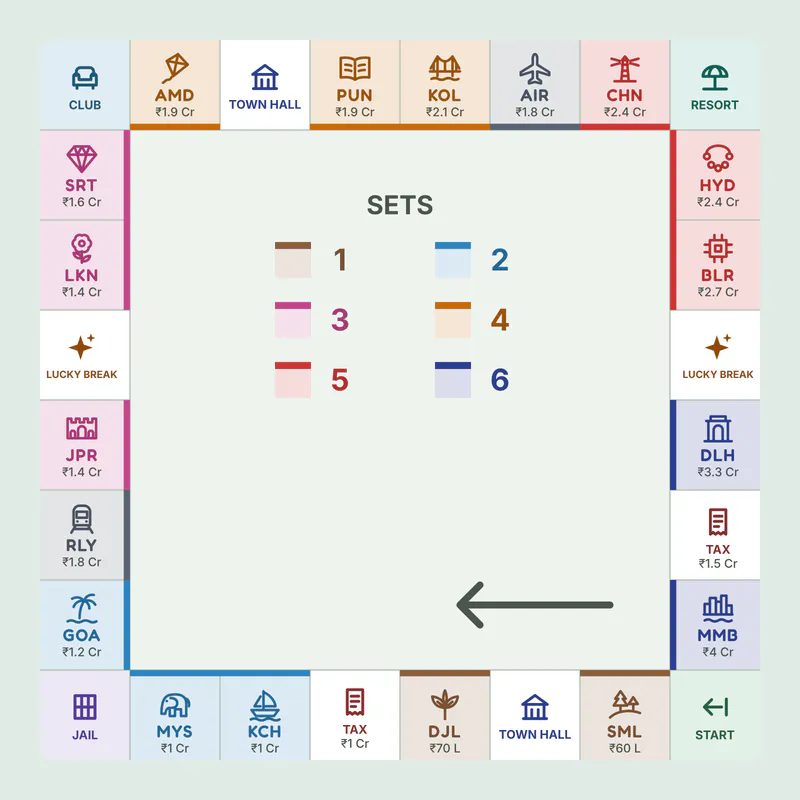
The 8 × 8 India board. Start is in the bottom right corner and play runs clockwise, along the bottom row first. Each place’s band shows its set, from set 1 near Start to set 6 at the end of the lap; RLY and AIR are the two transport spaces.
Overview
| Feature | Details |
|---|---|
| Players | 2 to 6 (any seat can be a computer player) |
| Equipment | A board of 28 spaces (36 on the 10 × 10 board), two dice, cash, two decks of 12 cards |
Objective
In a Quick game the richest player after the last round wins. In a Classic game players drop out when they can’t pay, and the last one left wins.
The board
The board has 28 spaces, 8 to a side, with a corner at each end of a side. Going clockwise from the bottom right:
- Start (corner). Every time you pass or land on it you collect the ₹1.5 crore salary.
- Jail (corner). Land here and you are in Jail.
- Club (corner). Land here and you pay the club fee of ₹50 lakh.
- Resort (corner). A free rest where nothing happens, unless the Pot on Resort option is on.
- 16 places in six sets: two places in set 1, three each in sets 2 to 5, and two in set 6. Prices rise as you go round, from Shimla at ₹60 lakh to Mumbai at ₹4 crore.
- 2 transport spaces: Railway and Airport, ₹1.8 crore each.
- 4 card spaces: two Lucky Break and two Town Hall.
- 2 taxes: Income tax (₹1 crore) and GST (₹1.5 crore).
Setup and options
Each player gets a token and the same starting cash, and everyone starts on Start. In the setup you choose:
- Players. Two to six, each a person or a computer player (Easy, Medium or Hard).
- Game length. Classic (the default) plays until one player is left, however many rounds that takes. Quick ends after a set number of rounds: 10, 20, 40 or 80, with 20 as the default, set in More options.
- Board size. 8 × 8 or 10 × 10, in More options. Quick starts on 8 × 8 and Classic on 10 × 10; after picking the length you can change it.
- Board. India, United States, United Kingdom, Australia or Planets. Boards change the names, the drawings and the currency, never the rules or the numbers. Preview shows the picked board at its size.
- Currency. The board’s own or any other.
- Starting cash. Low (₹10 crore), Normal (₹15 crore) or High (₹20 crore).
- Pot on Resort. Off by default. When it is on, taxes, the club fee, the Jail fine and cards that make you pay go into a pot, and whoever lands on Resort takes it.
- Pass screen. Optional, between turns.
The first player in the list starts; Rematch passes the first turn to the next player.
A turn
- Before you roll you may build or sell homes, mortgage a place or lift a mortgage, and offer trades.
- Roll the two dice and move your token that many spaces clockwise.
- Passing or landing on Start pays your salary on the way.
- Do what the space says: buy it or pass, pay rent, tax or the club fee, draw a card, or go to Jail.
- Doubles roll again. Your turn passes to the next player once you have rolled anything but doubles.
There is no Undo: a move can’t be taken back.
Step through a turn and the next
Step 1 of 6: Asha and Dev have moved three times each, paying the Income tax and the club fee on the way, and stand on Resort with ₹13.5 crore each. Nothing is bought yet. Asha rolls next.
Doubles
When both dice show the same number you move as usual, deal with the space, then roll again. A third doubles in the same turn sends you straight to Jail without moving, and your turn ends.
Buying places
Land on a place or transport space that nobody owns and you choose Buy (at its price) or Pass. There is no auction: a place you pass on stays with the bank, and the next player who lands there may buy it. If you don’t have enough cash, the game passes for you.
Rent
Land on a space another player owns and you pay them rent at once:
- A place on its own pays its base rent, from ₹3 lakh for Shimla to ₹48 lakh for Mumbai.
- A whole set: when one player owns every place of a set, each of those places pays double its base rent.
- Homes and a tower: rent rises with each home, and a tower pays the most.
- Transport: ₹30 lakh, or ₹80 lakh when one player owns both.
- Mortgaged spaces pay nothing, and you never pay rent on your own.
| Place | Set | Price | Rent | 1 home | 2 homes | 3 homes | 4 homes | Tower |
|---|---|---|---|---|---|---|---|---|
| Shimla | 1 | ₹60 L | ₹3 L | ₹25 L | ₹75 L | ₹1.7 Cr | ₹2.1 Cr | ₹2.5 Cr |
| Darjeeling | 1 | ₹70 L | ₹4 L | ₹25 L | ₹75 L | ₹1.8 Cr | ₹2.2 Cr | ₹2.6 Cr |
| Kochi | 2 | ₹1 Cr | ₹6 L | ₹35 L | ₹1 Cr | ₹2.3 Cr | ₹2.9 Cr | ₹3.3 Cr |
| Mysuru | 2 | ₹1 Cr | ₹6 L | ₹35 L | ₹1 Cr | ₹2.3 Cr | ₹2.9 Cr | ₹3.3 Cr |
| Goa | 2 | ₹1.2 Cr | ₹8 L | ₹35 L | ₹1.1 Cr | ₹2.5 Cr | ₹3 Cr | ₹3.5 Cr |
| Jaipur | 3 | ₹1.4 Cr | ₹10 L | ₹70 L | ₹2.1 Cr | ₹4.9 Cr | ₹6.1 Cr | ₹7 Cr |
| Lucknow | 3 | ₹1.4 Cr | ₹10 L | ₹70 L | ₹2.1 Cr | ₹4.9 Cr | ₹6.1 Cr | ₹7 Cr |
| Surat | 3 | ₹1.6 Cr | ₹12 L | ₹75 L | ₹2.2 Cr | ₹5.1 Cr | ₹6.2 Cr | ₹7.3 Cr |
| Ahmedabad | 4 | ₹1.9 Cr | ₹15 L | ₹85 L | ₹2.5 Cr | ₹5.8 Cr | ₹7.1 Cr | ₹8.3 Cr |
| Pune | 4 | ₹1.9 Cr | ₹15 L | ₹85 L | ₹2.5 Cr | ₹5.8 Cr | ₹7.1 Cr | ₹8.3 Cr |
| Kolkata | 4 | ₹2.1 Cr | ₹17 L | ₹85 L | ₹2.6 Cr | ₹6 Cr | ₹7.3 Cr | ₹8.5 Cr |
| Chennai | 5 | ₹2.4 Cr | ₹21 L | ₹1.2 Cr | ₹3.7 Cr | ₹8.7 Cr | ₹10.6 Cr | ₹12.4 Cr |
| Hyderabad | 5 | ₹2.4 Cr | ₹21 L | ₹1.2 Cr | ₹3.7 Cr | ₹8.7 Cr | ₹10.6 Cr | ₹12.4 Cr |
| Bengaluru | 5 | ₹2.7 Cr | ₹25 L | ₹1.3 Cr | ₹3.8 Cr | ₹8.9 Cr | ₹11 Cr | ₹12.8 Cr |
| Delhi | 6 | ₹3.3 Cr | ₹35 L | ₹1.7 Cr | ₹5.2 Cr | ₹12.1 Cr | ₹14.9 Cr | ₹17.3 Cr |
| Mumbai | 6 | ₹4 Cr | ₹48 L | ₹1.8 Cr | ₹5.5 Cr | ₹12.7 Cr | ₹15.7 Cr | ₹18.2 Cr |
Building homes and a tower
Once you own every place of a set and none of them is mortgaged, you can build there on your turn, before you roll. Each tap of Build adds one home:
- A home costs ₹50 lakh on sets 1 and 2, ₹1 crore on sets 3 and 4, ₹1.5 crore on set 5 and ₹2 crore on set 6.
- Build evenly. The game puts each new home on the place of the set with the fewest, so no place is ever more than one home ahead of another.
- After four homes, the next one turns them into a tower, at the price of one more home. On the Planets board you build domes and a station instead; they cost and pay the same.
- Selling works the other way: a home sells back to the bank for half its cost, from the place with the most first. You can sell before you roll or while you are raising cash.
Mortgages
Short of cash? Mortgage a place you own and the bank lends you half its price: ₹30 lakh for Shimla, ₹2 crore for Mumbai. A mortgaged space pays no rent, but the other places of its set still pay double. You can’t mortgage a place while its set has homes on it, so sell those first.
To lift a mortgage, pay back the loan plus 10%: ₹33 lakh for Shimla, ₹2.2 crore for Mumbai.
Trades
Before you roll, you can offer a trade to one other player. A trade can include:
- Places from sets with no homes on them (mortgaged places move as they are, still mortgaged),
- Cash, in steps of ₹10 lakh,
- Release cards that get a player out of Jail.
The player you ask answers it at once with Accept or Decline, before your turn goes on. You may make three offers a turn.
Lucky Break and Town Hall cards
Land on a card space and you draw from its deck: Lucky Break or Town Hall, 12 cards each. A deck shows every one of its cards once before any comes round again. Cards may:
- pay you cash, or make you pay the bank,
- move you to a place or to Start (collecting the salary when you pass it), or to the nearest transport space,
- move you back two spaces,
- send you to Jail,
- give you a release card to keep until you need it,
- charge repairs for every home and tower you own.
If a card moves you, the space you arrive on counts as landed on.
Taxes and the club fee
Landing on Income tax costs ₹1 crore; landing on GST costs ₹1.5 crore; landing on Club costs the club fee, ₹50 lakh. You pay as you land.
Jail
You are in Jail when you land on its corner, draw a card that sends you there, or roll three doubles in one turn. There is no just visiting: a token that stops on the corner is in. A card or a third double takes you straight there, without passing Start. Either way your turn ends, even after doubles. To leave:
- Pay the fine of ₹50 lakh before you roll, then roll and move as usual.
- Use a release card, then roll as usual.
- Roll doubles. You get three tries, one a turn. Doubles take you out and move you by that roll, with no roll again afterwards. A miss ends your turn.
After your third miss, the fine (or a card) is the only way out.
When you can’t pay
If you owe more cash than you have, raise cash by selling homes, mortgaging places or offering trades, then tap Pay. You can’t build or lift mortgages while you owe.
If you can’t raise enough, tap Leave the game. Your homes go back to the bank for half their cost first. Then:
- Owing a player: they get all your cash, your places as they are (mortgaged ones stay mortgaged) and your release cards.
- Owing the bank (a tax or a card): your places go back to the bank, unmortgaged and for sale again.
A player stuck in Jail with no tries left, no release card and less than the fine can also leave this way.
How the game ends
- Quick: after the last turn of the chosen round, the richest player wins. A round ends each time play comes back round to the player who went first.
- Classic: the last player left wins. There is no round limit: the game goes on until everyone else has left.
To choose a length, see how a Business game ends. Richest means worth, not cash alone: your cash, plus the price of each place you own (half for a mortgaged one), plus what your homes cost. If two players are worth the same, the one with more cash wins; if that is the same too, they share the win.
The 10 × 10 board
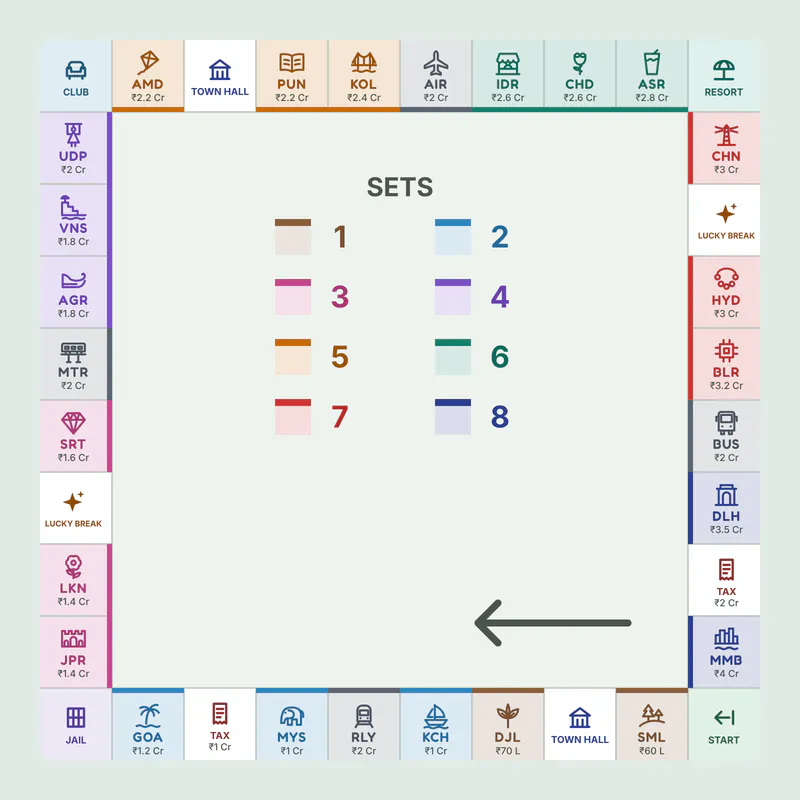
The 10 × 10 India board. Sets 4 and 6 (Agra, Varanasi and Udaipur; Indore, Chandigarh and Amritsar) are the two it adds, and RLY, MTR, AIR and BUS are the four transport spaces.
Every rule above holds on the bigger board; only the board and its numbers change:
- 36 spaces, 10 to a side, with the same four corners.
- 22 places in eight sets: two in sets 1 and 8, three in each of the others. Set 4 costs ₹1.8 crore to ₹2 crore a place, set 6 ₹2.6 crore to ₹2.8 crore. Shimla to Surat, and Mumbai, cost what they do on 8 × 8; its other places cost more.
- 4 transport spaces: Railway, Metro, Airport and Bus stand, ₹2 crore each. Rent is ₹25 lakh, ₹50 lakh, ₹1 crore or ₹2 crore as one player owns one, two, three or all four.
- Salary ₹2 crore; starting cash ₹15 crore, ₹20 crore or ₹25 crore (Low, Normal, High).
- GST is ₹2 crore; Income tax, the club fee and the fine stay the same.
- Homes cost ₹50 lakh on sets 1 and 2, ₹1 crore on sets 3 and 4, ₹1.5 crore on sets 5 to 7 and ₹2 crore on set 8. Rents are the bigger board’s own: tap a space in the game to see them.
Family rules and the rules here
Common family rules, and what this site does:
- Auctions. Some groups auction a place the first player passes on. Here it simply stays for sale.
- Money on the free corner. Many tables put taxes and fines in the middle for whoever lands on the free corner. Here that is the Pot on Resort option, off by default.
- No rent from Jail. Some say a player in Jail can’t collect. Here you collect rent as usual.
- Extra spaces. Many boxed sets sold in India add spaces such as a club or a wealth tax, with rules that vary from set to set. Here Club is a corner with a fixed fee, and the two taxes are Income tax and GST.
Glossary
- Place: a space you can buy, in one of six sets (eight on the 10 × 10 board).
- Transport space: Railway or Airport on the 8 × 8 India board.
- Release card: a card that gets you out of Jail.
- Worth: cash plus places and homes, the score that decides a Quick game.
For strategy, read how to win the Business game; for where the game comes from, how real estate board games work. To play with friends who aren’t in the room, play Business Tycoon online with friends.