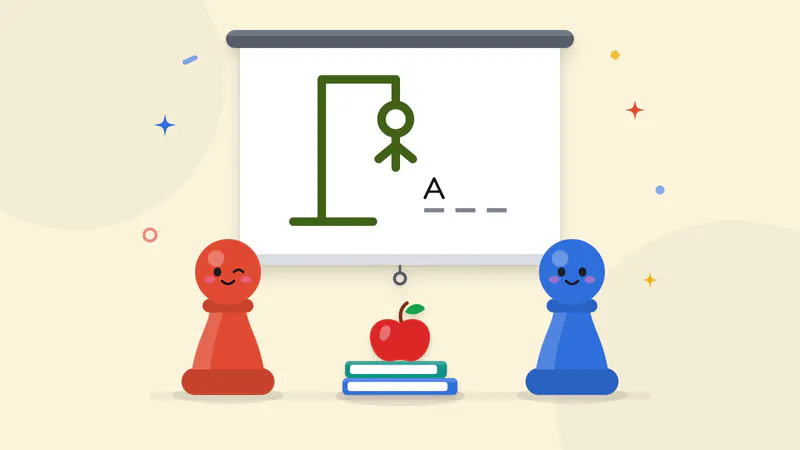
Hangman is a word-guessing game for two or more players. One player, the word setter, thinks of a secret word and draws a blank for each letter. The others, the guessers, call out letters. A correct letter is written into every blank where it belongs; a wrong letter adds one part to a simple drawing of a figure on a gallows. The guessers win if they complete the word, and the setter wins if the drawing is finished first. This guide explains how to play hangman: every rule, the variants people play, which rules this site uses, and how to choose words that make a good round.
Overview
| Feature | Details |
|---|---|
| Players | 2 or more (one setter, the rest guess). On this site: 1 player against the computer, or 2 to 4 people |
| Typical time | 2 to 5 minutes per round |
| Ages | About 6 and up, as soon as a child can spell short words |
| Equipment | Paper and a pencil, a whiteboard, or one shared device |
| Other names | Hanged Man, Guess the Word |
The origins of Hangman are uncertain. A version called “Birds, Beasts and Fishes”, in which players guessed the name of an animal from its first and last letters, appears in a collection of British children’s games published in the 1890s, and it is still a common classroom game because it needs nothing but something to write on.
Setup
Decide who sets the first word. The setter thinks of a word or a short phrase and draws one blank for each letter, leaving a gap between words. The guessers should not see the word, so on paper the setter writes it down privately or simply keeps it in mind.
Next to the blanks, leave room for the drawing and for a list of wrong letters. Agree on how many wrong guesses are allowed (see below) and whether the setter gives a hint, such as a category.
On this site, the setup panel does all of this. Play alone (2 players, vs Computer) and the computer is the setter: you choose a category (Any, Animals, Food, Places, Sports, Things, Nature, Jobs or Transport) and a computer level (Easy, Medium or Hard), which sets how difficult its words are, and it picks a word from its built-in list. Play with 2 to 4 people and you take turns as the setter; with 3 or 4 players, one seat can be a computer that sets every word while the people guess (any other computer seat guesses letters with them as a teammate). In both modes you choose the number of lives: 6, 8 or 10.
Objective
The guessers try to reveal the whole word before they run out of lives. The setter tries to choose a word that the guessers cannot finish in time. Nobody is trying to be fast: careful guesses matter more than quick ones.
Taking turns
A round is a series of guesses. On each turn, a guesser either names one letter or tries to say the whole word. The setter answers every guess honestly and updates the blanks or the drawing.
With one guesser, that player makes every guess. With several guessers, they take turns in order around the table, one guess each, and share the result. On this site the guessers take turns in seat order, starting with the player after the setter, and the turn indicator shows who is next. When the computer sets the word, Rematch moves the first guess one seat along instead (if that is the computer’s own seat, the player after it starts).
The rules in detail
Guessing a letter
The guesser names a letter from A to Z. If it is in the word, the setter writes it into every blank where it appears. If it is not, the setter adds it to the list of wrong letters and draws one more part of the figure. On this site you can tap a letter on the on-screen keyboard or press it on a physical keyboard; upper and lower case are treated the same.
Repeated letters are revealed together
A letter that appears several times is revealed in all its places at once and counts as a single guess. In BANANA, guessing N fills in both N’s, and guessing A fills in all three A’s. A setter who reveals only one copy is breaking the rules.
Wrong guesses and the drawing
Each wrong guess, a missing letter or a wrong word, costs one life and adds one part to the drawing. Right guesses never cost a life. The classic picture uses six parts after the gallows has been drawn: head, body, left arm, right arm, left leg, right leg. When the last part is drawn, the guessers have lost the round.
This site offers 6, 8 or 10 lives. With 6, the gallows is already standing and the six parts of the figure are added one by one. With 8, the top beam and the rope are added first. With 10, the whole picture is built from the ground up: base, post, beam, rope, then the figure. The figure is always complete on the last life, and the counter shows how many lives are left.
Guessing the whole word
At any point, a guesser may say the whole word instead of a letter. If it is right, the guessers win the round immediately, even with blanks still showing. If it is wrong, it costs a life just like a wrong letter, and the turn passes on. The same wrong word cannot be tried twice. When you guess a phrase, spaces and hyphens do not matter: HOT DOG and HOTDOG count as the same guess. On this site a whole-word guess must have as many letters as there are blanks, so a guess that cannot fit, such as a single letter typed into the word box, is refused instead of costing a life.
Phrases, spaces and hyphens
Secret phrases such as ICE CREAM or JACK-IN-THE-BOX are allowed. Spaces and hyphens are shown from the start, so the guessers can see how many words there are and how long each one is. Only letters ever need guessing.
Letters already guessed
A letter can only be guessed once. On paper, the list of wrong letters stops anyone from repeating a miss. On this site the keyboard marks every used letter, with a tick for a hit and a cross for a miss, and a used letter cannot be chosen again, so no life is ever lost by accident.
What counts as a valid secret word
The setter must choose a real word or phrase that they can spell correctly. Most groups ban names of people, brands and places. On this site a secret may use only the letters A to Z, with single spaces or hyphens between words; it must have at least 3 letters and at most 24 characters in all. The setter may add a short hint of up to 24 characters, such as “Something you eat”, which the guessers see next to the drawing.
Keeping the word secret on one device
When people share a phone or tablet, the word must stay hidden from the guessers. On this site the setter gets a pass screen first, so everyone else can look away. The word is hidden while it is typed. Then a second pass screen hands the device to the first guesser before the blanks appear. These two screens always appear in a game with friends, even if the optional pass screen between turns is switched off. When the computer is the setter, no pass screens are needed.
Winning, losing and scoring
A round ends in one of two ways, and it can never be a draw:
- The word is complete. Every letter has been revealed, or someone guessed the whole word. The guessers win the round. With several guessers, they all win it together.
- The drawing is complete. The guessers used their last life. The setter wins the round, and the full word is revealed so everyone can see what it was.
To play a longer game, play several rounds and change setters each time. On this site, Rematch starts the next round and passes the job of setter to the next player in order, and a session score counts the rounds each person has won, whether as a guesser or as the setter. After everyone has set the same number of words, the player with the most rounds is ahead. Playing against the computer, the score shows the words you found next to the rounds the computer won.
Variants and house rules
Hangman is played in many slightly different ways. Agree on these points before the first round.
| Variant | How it works | On this site |
|---|---|---|
| Number of wrong guesses | Anything from 6 to 13, depending on how much of the picture is drawn (some groups add a face, hands or feet) | 6, 8 or 10 lives |
| First and last letter shown | The setter fills in the first and last letters at the start, as in the old “Birds, Beasts and Fishes” game | Not used; all letters start blank |
| Wrong word ends the round | A wrong whole-word guess loses at once | A wrong word costs one life |
| Category hint | The setter names a theme, such as animals or food | The computer always names the category; friends may add their own hint |
| Different drawing | A melting snowman, a flower losing petals, a ladder or a balloon instead of a figure | One simple, friendly line figure |
| Point for the last letter | With several guessers, whoever completes the word scores | The guessers win as a team |
| Free vowels | All vowels are shown at the start, which makes very long words fair | Not used |
How to pick good words
A good secret word is one the guessers know but cannot easily reach. Long words are often easier than short ones, because each guess has more letters to hit. These ideas make a word harder:
- Use rare letters. J, K, Q, V, X and Z turn up in few words, so guessers try them late. Short words such as YAK, JAZZ or FJORD are surprisingly hard.
- Avoid the most common letters. A word with no E, or with only one vowel, slows everyone down. RHYTHM and LYNX have no A, E, I, O or U at all.
- Avoid giveaway endings. Words ending in -ING, -ER, -ED or -TION fill in quickly once a couple of letters appear.
- Mind the letter count. A word with many different letters gives more chances to hit. A word with few distinct letters, such as KIWI, gives fewer.
- Choose fairly. Pick a word the guessers have a real chance of knowing, check your spelling, and match the word to the players’ age. Stumping a seven-year-old with a rare science term is not much fun for anyone.
For guessers’ tactics, such as which letters to try first and how to read a pattern of blanks, see the hangman strategy tutorial.
Common mistakes and rule disputes
- Misspelling the secret word. The round is spoiled if the setter spells the word wrongly. On paper, the setter should write it down privately first; on this site, type it carefully on the private screen.
- Revealing only one copy of a letter. Every copy must be shown at once.
- Charging a life for a correct guess. Only wrong letters and wrong words cost lives.
- Repeating a letter. On paper, a repeated letter is usually ignored rather than charged. On this site, used letters cannot be picked again.
- Arguing about plurals and spellings. Agree beforehand whether plurals, hyphenated words and phrases are allowed. The built-in list avoids words with two common spellings.
- Peeking during word entry. Use the pass screen and look away until it is your turn.
Glossary
- Word setter: the player who chooses the secret word for the round.
- Guesser: a player trying to find the word.
- Blank: a line standing for one unknown letter.
- Hit: a guessed letter that is in the word.
- Miss: a guessed letter that is not in the word, or a wrong whole-word guess.
- Life: one allowed miss. When the lives run out, the round is lost.
- Hint: a short clue, such as a category, shown to the guessers.
- Round: one secret word from start to finish.
- Rematch: start the next round with the next player as the setter.
Play it now
Open Hangman to play a round on your own against the computer’s word list, or with 2 to 4 people on one device. To get better at guessing, the beginner strategy tutorial walks through a full round. If your group likes quick games that started on paper, our list of pen and paper games has more, and teachers can find tips for running word games with a class in classroom games on one screen.