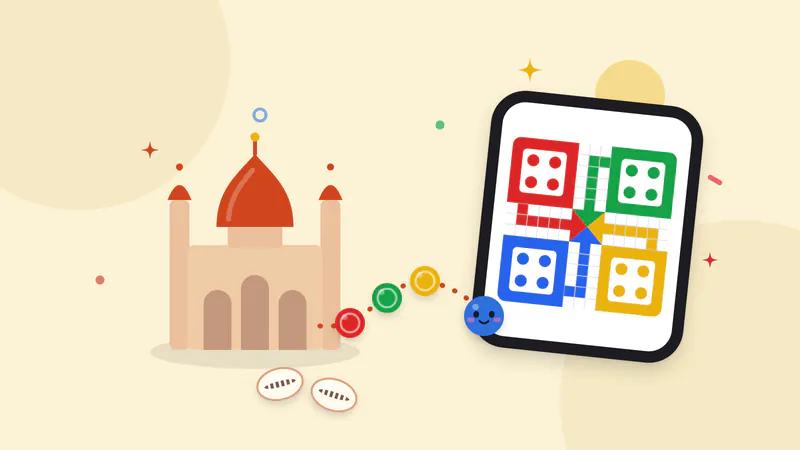
Ludo is a race game for two to four players. Each player has four tokens that start in a corner yard. You roll one die, need a 6 to bring a token onto the board, then race it once around the cross-shaped track and up your own home column to the center. Land on a lone rival token and it goes back to its yard. The first player to bring every token home wins. This guide explains each rule in the order you meet it, the house rules people argue about, and exactly which version you play in our free Ludo game.
Overview
| Feature | Details |
|---|---|
| Players | 2 to 4 (computer players can fill empty seats) |
| Typical time | 10 to 30 minutes; the two-token quick game takes less than half as long |
| Ages | About 5 and up |
| Equipment | A Ludo board, one six-sided die and four tokens in each of four colors |
| Type | Dice race game with captures and safe squares |
Ludo is the English descendant of Pachisi, the cross-and-circle race game of India, simplified in Victorian England with a square board, a single die and corner yards. The rules below are the version most families and apps use today, including the star safe squares common on Indian boards. For the full story, read the history of Ludo.
The board and setup
The board is a 15 by 15 grid shaped like a plus sign, with a square yard in each corner:
- Yards. Each corner belongs to one color: red at the top left, green at the top right, yellow at the bottom right and blue at the bottom left. All of a color’s tokens start in its yard.
- The track. The outer squares of the cross form a loop of 52 squares. Every token travels it clockwise.
- Start squares. Each color has a start square on the arm next to its yard. Tokens enter the track there.
- Stars. A star square sits eight squares past each start square, four in all.
- Home columns. The middle lane of each arm holds five squares in one color, leading to that color’s home triangle in the center. Only that color may enter it.
To set up, put each player’s tokens in their yard. With two players, use opposite corners (red and yellow on this site) so both players have open space on either side. With three players, one corner stays empty.
Objective
Move all of your tokens out of your yard, around the board and into your home triangle before anyone else does. From its start square a token travels 50 squares around the track, turns into its home column, and needs 6 more steps (five home-column squares and then home) to finish: 56 steps in all.
Turn order
Players take turns clockwise. Traditionally everyone rolls the die and the highest roll goes first. On this site a new game from the setup screen always starts with the first player in the list, and each rematch hands the first turn to the next player clockwise.
On your turn you roll the die and move one token by the number shown. Some rolls earn another roll, as explained below. Your turn ends with the first roll that doesn’t earn another one.
Movement and special rules
Rolling a 6 to leave the yard
A token in the yard can only come out on a 6. It moves onto your start square, and that uses the whole roll: you don’t count six squares from the yard. If all of your tokens are in the yard and you roll anything else, nothing can move and your turn is over. At the start of a game it often takes a few turns before anyone gets going.
Moving a token
After rolling, choose one token on the board and move it forward, clockwise, exactly the number of squares shown. Start counting on the square in front of the token. You can’t split a roll between two tokens, move backwards or skip a move you are able to make. When you roll a 6 and still have tokens in the yard, you choose: bring a new token out, or move a token that is already on the board six squares.
In the app, the tokens that can use your roll are highlighted. Tap one to move it.
Rolling a 6 gives another roll
Whenever you roll a 6, you make your move and then roll again. This applies even when no token can use the 6, for example when your only tokens left are too close to home.
Three 6s in a row
If you roll a 6 three times in a row in one turn, the third 6 is cancelled. You don’t move for it and your turn ends. The moves you made with the first two 6s stay where they are.
Capturing a token
If your token ends its move exactly on a square holding a single token of another color, that token is captured and goes back to its own yard. Many players in India call this cutting a token. Its owner needs another 6 to bring it out again, so capturing a token that has traveled far is a big setback for its owner.
Only the square where you stop counts. Passing over a rival token does nothing to it. A capture earns you a bonus roll.
Safe squares: start squares and stars
Eight squares are safe: the four start squares and the four stars. A token on a safe square can never be captured, and tokens of different colors may share a safe square. It also means a rival token sitting on your start square never stops you from bringing a token out. You simply share the square.
Sharing squares and pairs
Your own tokens may share any square. Two or more tokens of one color on the same square form a pair, and a pair can’t be captured, even on an ordinary square. A rival who lands on a pair just shares the square with it. If a square holds a pair of one color and a single token of another, landing there captures only the single token.
On this site pairs don’t block. Any token may pass a pair or land beside it. Blockades are a popular house rule, covered in the variants table below.
The home column
A token never starts a second lap. When it comes back around to its own arm, it leaves the track at the middle square on the outer edge and turns into its home column instead of passing its start square again. No other color can enter your home column, so a token there is completely safe.
The exact roll to reach home
A token finishes by moving exactly onto the home triangle. If you roll more than the squares it has left, that token can’t move, and you must move a different token. For example, a token three squares from home can finish with a 3, can step closer with a 1 or a 2, and can’t use a 4, 5 or 6.
Bonus roll for reaching home
Bringing a token home earns a bonus roll, just like a 6 or a capture. Bonuses don’t add up: a 6 that also captures gives one extra roll, not two. The winning move is the one exception, because it ends the game and there is nothing left to roll.
When no token can move
If none of your tokens can use the roll, because they are all in the yard without a 6 or too close to home for the number, your turn passes. The app does this for you and shows a short message. If the roll was a 6, you still roll again.
Winning and ending the game
The first player to bring all four tokens home wins. In the two-token quick game, two tokens home is enough. Ludo can’t end in a draw, because someone always finishes first.
Many groups keep playing to decide second, third and last place. This site ends the game as soon as the winner is known and ranks everyone else by how far their tokens have traveled, with tokens still in the yard counting as zero.
Options on this site
- Tokens per player: 4 for the classic game or 2 for a quick game.
- Auto-move: when there is only one possible move, the token moves by itself. That includes a 6 with every token still in the yard, or several tokens on the same square, since they all end up in the same place. It is on by default; switch it off to make every move yourself.
- Players: 2 to 4, and every seat can be a person or a computer.
Common variants and house rules
Ludo has no single governing body, so families and apps differ. Agree on these before you start:
| Rule | Common variations | On this site |
|---|---|---|
| Leaving the yard | Only on a 6; on a 1 or a 6; on a 5 in Spanish-style games | Only on a 6 |
| Extra rolls | For a 6 only; also for a capture and for reaching home | For a 6, a capture or reaching home, one per move |
| Three 6s in a row | Turn ends; the turn’s earlier moves are undone too; no limit | Turn ends, earlier moves stand |
| Safe squares | None; start squares only; start squares and stars | Four start squares and four stars |
| Pairs | Block other tokens from passing; can’t be captured; no special rule | Can’t be captured, don’t block |
| Rival on your start square | Captured when you bring a token out; safe | Safe, you share the square |
| Overshooting home | Not allowed; the token bounces back | Not allowed, exact roll needed |
| Capture before home | Some house rules require one capture before entering the home column | Not used |
| End of the game | Play on until every place is decided | Ends at the first winner |
| Teams | Partners in opposite corners | Everyone plays alone |
Common mistakes and rule disputes
- Counting from the yard. A 6 brings a token onto the start square and that is the whole move. The token doesn’t travel six squares beyond it.
- Counting the square you’re on. Count from the square in front of your token. A roll of 1 moves it to the very next square.
- Capturing on a safe square. Stars and start squares protect every token on them, whatever the color.
- Forgetting bonus rolls. A capture or a token reaching home earns a roll, not only a 6.
- Playing the third 6. It is cancelled and the turn passes.
- Treating a pair as a wall. In these rules a pair is safe from capture, but it doesn’t stop anyone from passing.
- Splitting a roll. One die, one roll, one token. You can’t move one token 2 and another 4 with a 6.
Glossary
- Token: a playing piece. Also called a counter or pawn, and a goti in Hindi.
- Yard: the corner area where a color’s tokens wait to enter the board.
- Start square: the colored square where a token enters the track. It is a safe square.
- Track: the loop of 52 squares around the cross that every token travels clockwise.
- Star: one of the four safe squares eight squares past each start square.
- Safe square: a start square or star, where no token can be captured.
- Capture (cut): landing exactly on a single rival token to send it back to its yard.
- Pair: two or more tokens of one color on the same square. A pair can’t be captured.
- Home column: the five squares in your color that lead from the track to the center.
- Home: your colored triangle in the center of the board, the finish.
- Bonus roll: an extra roll earned by a 6, a capture or a token reaching home.
Ready to try it? Start a game of Ludo with friends on one device or against the computer. When you know the rules, the beginner’s Ludo tutorial covers when to leave the yard, how to stay safe and when to chase. For another dice race from India, see Snakes and Ladders.