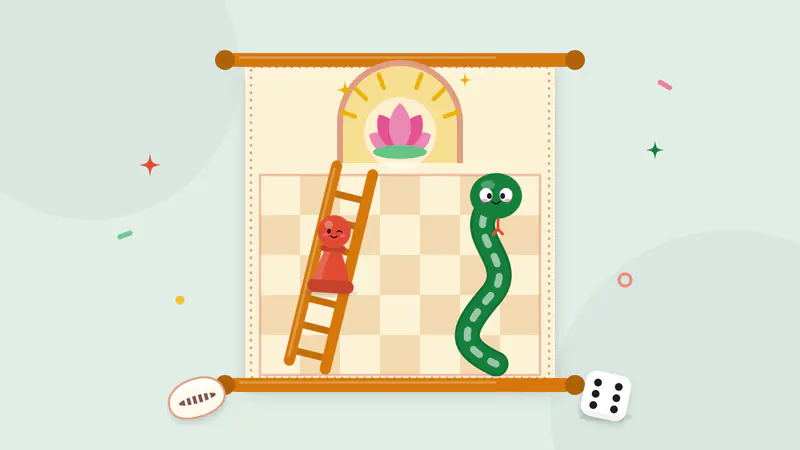
Snakes and Ladders is a race game for two or more players on a board of 100 numbered squares. On your turn you roll one die and move your token forward that many squares. If you land on the bottom of a ladder, you climb to its top; if you land on the head of a snake, you slide down to its tail. The first player to reach square 100 wins. There are no decisions at all, so it is pure luck. This guide explains each rule in detail, the variants families argue about, and exactly which rules the game on this site uses.
Watch: how to play Snakes and Ladders
How to Play Snakes and Ladders: Rules Explained Simply
Chapters
Overview
| Feature | Details |
|---|---|
| Players | 2 or more at a table; 2 to 6 on this site, including computer players |
| Typical time | 5 to 15 minutes |
| Ages | Young children who can count to six, and everyone older |
| Equipment | A 10×10 board of 100 squares, one six-sided die, one token per player |
| Skill | None: every move is decided by the die |
| Other names | Snake and ladder, snake and ladder game, Snakes & Ladders |
The game comes from India, where older versions such as Moksha Patam, Gyan Chaupar and Paramapada Sopanam used the ladders for virtues and the snakes for vices. It reached England in the late 1800s and became the simple race played today. The history of Snakes and Ladders tells that story in more detail.
The board
The board is a 10×10 grid numbered from 1 in the bottom-left corner to 100 in the top-left corner. The numbers wind back and forth: the bottom row runs 1 to 10 from left to right, the next row runs 11 to 20 from right to left, the next 21 to 30 from left to right again, and so on up the board. Following the numbers, your token never jumps from one side of the board to the other. It always moves to a square next to the one it just left.
Ladders and snakes are drawn across the grid. Each ladder has a foot on a lower square and a top on a higher one. Each snake has its head on a higher square and its tail on a lower one. Their positions are different on every printed board.
Setting up
- Give each player a token or counter in a different color.
- Place every token off the board, just before square 1. Nobody starts on the board.
- Decide who goes first. A common tradition is that everyone rolls once and the highest roll starts. Play then continues in order around the table.
On this site you type the players’ names and choose, for each seat, a person or a computer player. In a two-player game you also pick who rolls first. After each game, Rematch passes the first roll to the next player so the start rotates fairly.
Objective
Be the first player to move your token all the way to square 100.
How a turn works
- Roll the die. One six-sided die, once.
- Move forward that many squares along the numbers. Count the first square in front of your token as one; never count the square you are standing on.
- Check the square you landed on. The foot of a ladder takes you up to its top. The head of a snake takes you down to its tail.
- Pass the die to the next player.
You must move the full roll every turn (apart from the exact-finish rule below), and you can never choose to stay put or to move backward.
The rules in detail
Entering the board
Tokens start off the board, so your first roll moves you onto it: a 1 puts you on square 1, a 5 on square 5. No special number is needed to start.
Climbing ladders
If your move ends exactly on the foot of a ladder, move your token straight up to the square at the top of the ladder. Your turn then ends on that square. Landing on the top of a ladder does nothing special, and you never go down a ladder.
Sliding down snakes
If your move ends exactly on the head of a snake, slide your token down to the square at the snake’s tail. Your turn ends there. Landing on a snake’s tail does nothing, and you never go up a snake.
Only the landing square counts
Snakes and ladders only work on the square where your move ends. If your count passes over the foot of a ladder or the head of a snake on the way, nothing happens. On this site’s board, for example, moving from 22 to 26 passes the snake on 25 safely.
Sharing a square
Any number of tokens can stand on the same square. Landing on another player’s square does not capture them or send them back.
Exact roll to finish
Many families play that you must land exactly on square 100. If your token is on 97, you need a 3; a 4, 5 or 6 is too big. There are two common ways to handle a roll that is too big:
- Stay: your token does not move, and you try again next turn.
- Bounce back: count up to 100 and then back down with the rest of the roll, so a 5 from 97 ends on 98.
This site uses stay, and the rule is on by default (the setup switch is called Exact roll to finish). Snakes and ladders still work during the finish: on this site’s board, landing exactly on 98 slides you down a snake to 80. With the switch off, no exact roll is needed: any roll that reaches or passes 100 takes you to 100 and wins.
Extra roll on a six
A common house rule gives another roll to a player who rolls a 6. On this site it is the Extra roll on 6 switch, off by default. When it is on:
- every 6 earns another roll, with no limit on how many in a row;
- the extra roll comes after any ladder or snake on the square you landed on;
- a 6 that is too big for the exact finish still earns the extra roll, even though the token stays put;
- a 6 that reaches 100 wins at once, so there is nothing more to roll.
Some families add a limit, such as losing the turn after three sixes in a row. This site has no such limit.
Winning and ending the game
The first player to reach square 100 wins, and the game ends immediately. Because players roll one at a time, two players can never arrive together, so there are no draws. With three or more players, the results list everyone else in order of how far they got, with ties going to whoever would have rolled next. If your group prefers to keep playing for second and third place, that works on a printed board; on this site the race ends with the winner.
Variants and house rules
Rules vary from family to family and from board to board. This table shows the common choices and what this site does.
| Rule | Common choices | On this site |
|---|---|---|
| Starting | Off the board, or on square 1 | Off the board |
| Needing a 6 to start | Yes or no | No |
| Number of dice | One die, or two for a faster game | One die |
| Finishing | Exact roll with stay, exact roll with bounce back, or no exact roll | Exact roll with stay (switch it off for no exact roll) |
| Rolling a 6 | Nothing special, or another roll | Nothing special (switch it on for another roll) |
| Landing on another token | Share the square, or bump it back | Share the square |
| Who goes first | Highest roll, youngest player, or agreement | Chosen in the setup; rematches rotate |
Families also play with two dice (move the total, which makes the race shorter), power squares that give a bonus or penalty, and teams that share a token. The tutorial for playing with kids has more of these ideas.
The board on this site
The board used here is our own layout, with 8 ladders and 9 snakes. Every snake and ladder ends on a different square, so a ladder never drops you onto a snake’s head and a snake never drops you onto a ladder’s foot.
| Ladders (foot → top) | Snakes (head → tail) |
|---|---|
| 5 → 23 | 98 → 80 |
| 8 → 27 | 93 → 66 |
| 20 → 40 | 77 → 57 |
| 43 → 83 | 70 → 51 |
| 49 → 67 | 60 → 41 |
| 65 → 76 | 50 → 10 |
| 69 → 90 | 28 → 12 |
| 86 → 96 | 25 → 15 |
| 19 → 3 |
The longest ladder climbs 40 squares, from 43 to 83, and the longest snake drops 40, from 50 to 10. On average, one player racing alone needs about 35 rolls to reach 100 with the exact-finish rule and about 30 without it.
Common mistakes and disputes
Counting the square you are on. The first square you count is the one in front of your token. If you are on 12 and roll a 3, you finish on 15.
Going the wrong way along a row. At the end of each row, move up to the square directly above and carry on in the other direction. Following the numbers always shows the way.
Taking a ladder you only passed. Only the square where your move ends counts. Passing a ladder’s foot or a snake’s head on the way does nothing.
Going up a snake or down a ladder. Snakes only take you down and ladders only take you up. Landing on a ladder’s top or a snake’s tail is an ordinary square.
An extra turn for climbing a ladder. Climbing a ladder does not earn another roll. Only a 6 can, and only when that house rule is switched on.
Arguing about the finish. Agree before the game whether you need an exact roll to reach 100. On this site it is a switch in the setup, so there is nothing to argue about mid-game.
Glossary
- Token (or counter): the piece that shows where a player is.
- Square: one of the 100 numbered spaces on the board.
- Foot and top: the bottom and top ends of a ladder. Only the foot does anything.
- Head and tail: the two ends of a snake. Only the head does anything.
- Exact finish: the rule that you must land exactly on 100.
- Overshoot: a roll that would take you past 100.
- Stay and bounce back: two ways to handle an overshoot under the exact-finish rule.
- Extra roll: another roll earned by a 6, when that house rule is used.
- Boustrophedon: the back-and-forth numbering of the board, from a Greek word for the way an ox turns at the end of each furrow.
Play it now
The quickest way to learn is to play a round. Open Snakes and Ladders to race on one device with 2 to 6 players, with computer players in any empty seats. To teach the game to young children, practice counting with it or try some fun variants, read the Snakes and Ladders tutorial for kids. For another race game with real choices, try Ludo.