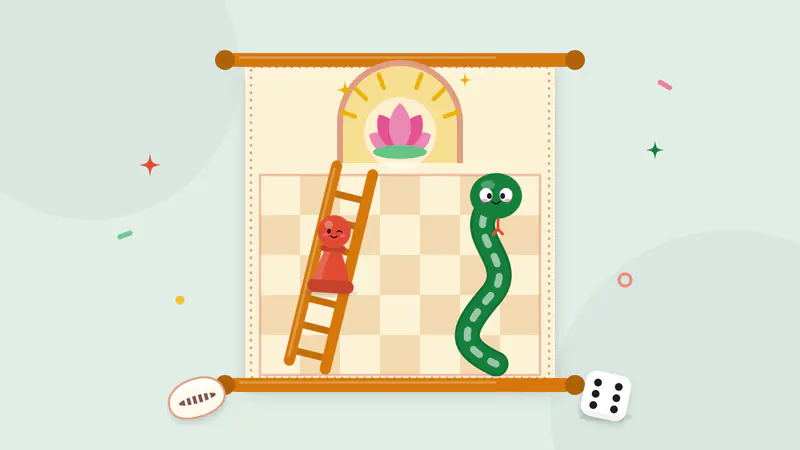
Snakes and Ladders is pure luck: nobody can play it better than anyone else. That makes it an ideal first board game. A child can beat a grown-up fairly, and every turn practices counting, taking turns and coping with a setback. This tutorial walks through a first game square by square, then covers how to keep it fun for young children, how to turn it into counting practice, and some variants for older kids. You can follow along on the Snakes and Ladders board.
What you will learn
- How to set up a game that suits your child’s age.
- How a turn works, with a real first game on this site’s board.
- Simple ways to turn each roll into counting and number practice.
- How to handle the long snakes without tears.
- Variants that make the game fresh for older kids.
If you need the rules first, the Snakes and Ladders rules guide covers every rule and the house rules families argue about.
Before you start
On this site, the setup takes a few seconds:
- Players: choose 2 to 6 seats and type each child’s name. Any seat can be a computer player, which only rolls the die for its seat. A single child can race against two or three computer players and still get a busy, colorful board.
- Exact roll to finish: on by default, so you must land exactly on 100. For very young children, switch it off: any roll that reaches 100 wins, and the ending is quicker. For children who can subtract, leave it on and it becomes a good puzzle (“You’re on 97. What do you need?”).
- Extra roll on 6: off by default. Switching it on adds excitement, because every 6 gives another roll.
- Pass screen: leave it off for young children. Everyone watches the same screen anyway.
Your first game, step by step
Here is the start of a two-player game between Maya (red) and Leo (blue) on this site’s board, with the standard options. Both tokens start off the board, just before square 1.
- Maya rolls a 5. She counts out loud as her token moves: “1, 2, 3, 4, 5.” Square 5 is the foot of a ladder, so she climbs all the way to 23. A great start, and a good moment to show how a ladder works.
- Leo rolls a 3 and moves to square 3. A snake’s tail ends there, but tails do nothing. Only a snake’s head sends you down.
- Maya rolls a 2. From 23 she counts “24, 25”, and 25 is a snake’s head. She slides down to 15. This is the moment to model a good reaction: “Oh no, down we go! You might find a ladder next time.”
- Leo rolls a 5. From 3 he counts 4, 5, 6, 7, 8. He passes the ladder on 5 without climbing it, because only the landing square counts, but square 8 has a ladder of its own. Up he goes to 27.
- Maya rolls a 5 again. She counts on from 15: “16, 17, 18, 19, 20.” Square 20 is the foot of a ladder, so she climbs to 40. Point out that she passed the snake’s head on 19 safely.
- Leo rolls a 1 and steps from 27 to 28, a snake’s head. He slides down to 12. Maya led, then Leo, then Maya again, all in six rolls, which is exactly why children love this game.
- A few turns later, Maya is on 97 and needs exactly 3 to finish. She rolls a 5, which is too big, so her token stays on 97. Ask her what she needs next time.
- Leo is on 84 and rolls a 2. Square 86 is the foot of a ladder, which carries him up to 96. Now both players are close to the finish.
- Maya rolls a 3 and lands exactly on 100. She wins, and the game ends straight away.
Every game follows the same pattern: roll, count, check the square, pass the die. After one or two games most children can run their own turns.
Tips for playing with young children
- Let them roll and count every square. Pressing Roll and counting the moves themselves is the fun part. Resist doing it for them, even when it is slow.
- Count on, don’t count again. Teach them to start from the next square (“16, 17, 18…”) instead of counting from 1. It is the same idea as counting on in early addition.
- Talk about snakes before they happen. Agree that sliding down is part of the game and happens to everyone. A long snake can drop the leader behind everyone, so nobody is ever really out of it.
- Celebrate other people’s ladders. Cheering when someone else climbs is an easy first lesson in good sportsmanship.
- Keep games short. Two players and the exact-finish switch off make a quick game for short attention spans. Stop after one game if they are tired. The game is saved after every roll, so you can finish it later.
- Use computer players to fill the board. A child playing alone against computer players still gets the noisy, lively feeling of a four-player race.
- Use Undo for slips, not for better rolls. If someone presses Roll out of turn, Undo takes the roll back, along with any computer rolls that came after it. The dice for each game are fixed, so rolling again gives the same numbers. Nobody can fish for a 6.
- Read the turn log together. The lines under the board, such as “Maya rolled 5” and “Ladder! Up to 40”, are good short reading practice for early readers.
Turn it into counting practice
The 100-square board is a number chart in disguise, so each turn is a chance to practice something:
- Recognizing numbers to 100. Ask “Which square are you on?” and have them read it. Each row holds one group of ten: the bottom row is 1 to 10, the next row is 11 to 20.
- Adding a small number. Before moving, ask “You’re on 15 and you rolled a 5. Where will you land?” Then count it out to check.
- Ladder subtraction. “How many squares did that ladder save you?” From 43 to 83 is 40 squares, the longest ladder on this board.
- Snake subtraction. “How far did you slide?” From 50 down to 10 is another 40.
- The exact finish. With the exact-finish rule on, “What do you need to reach 100?” is a real subtraction question that every player cares about.
- Odd and even. Before rolling, each player guesses whether the number will be odd or even.
Fun variants for older kids
Once the standard game feels easy, these house rules make it new again. They work on a printed or homemade board. The game on this site plays the standard rules, with the two setup switches for the exact finish and the extra roll on 6.
- Double dice. Roll two dice and move the total. The race is faster, and adding the two dice is good mental arithmetic.
- Power squares. Before the game, mark a few squares with special effects, such as “roll again”, “swap places with the player in front” or “go back three”. Kids love inventing their own.
- Team play. Pairs share one token and take turns rolling for their team. It works well when younger and older children play together.
- Choose your die. Roll two dice and move by either one, but not both. This adds a real decision: which number avoids the snake ahead?
- Bounce back. If a roll would pass 100, count up to 100 and back down with the rest. A 5 from 97 ends on 98, which on this site’s board would be a snake’s head.
- Draw your own board. Give children a blank 10×10 grid and let them place their own snakes and ladders. Then play on it. It is a fun way to think about which layouts make the game fair.
Common beginner mistakes
- Counting the starting square. The first square to count is the one in front of the token. If you are on 12 and roll a 3, you finish on 15, not 14.
- Getting lost at the end of a row. The numbers wind back and forth, so after 10 the path goes up to 11, directly above, and then runs the other way. Follow the numbers with a finger.
- Climbing a ladder you passed. Only the landing square counts. Passing a ladder’s foot or a snake’s head does nothing.
- Going down a ladder or up a snake. Ladders only go up and snakes only go down, and only from the foot or the head.
- Thinking there is a good way to roll. Blowing on the die or pressing Roll in a special way doesn’t change the number. It is a nice chance to talk about luck.
A simple practice plan
- First game: two players, exact finish off. Count every square out loud together.
- Second game: switch the exact finish on and talk about what number you need near the end.
- Third game: add one or two computer players for a bigger race, and let your child run every turn without help.
- Fourth game: switch on Extra roll on 6 and ask, before each roll, where each number would take them.
- Next step: move on to a game with real choices. In Ludo you also race around a board with a die, but you choose which token to move, and in Yacht Dice you decide which dice to keep.
Ready to try it? Open the Snakes and Ladders game, pick the number of players, and press Roll. To learn where the game came from, read the history of Snakes and Ladders.