In 8 ball pool two players, or two teams of two, share a table of fifteen numbered balls and a white cue ball. One side takes the solids, numbered 1 to 7, and the other the stripes, 9 to 15. You keep the table while you pocket your own balls, and once all seven are down you go for the black 8 ball: pocket it cleanly and the frame is yours, pocket it at the wrong moment and it goes to your opponent. This guide gives every rule exactly as this site plays it, in the order a visit to the table meets them, and ends with what it leaves out compared with tournament play.
Overview
| Feature | Details |
|---|---|
| Players | 2, or 4 in two teams of two (any seat may be the computer) |
| Typical time | 5 to 20 minutes for a frame |
| Equipment | A table with six pockets, 15 numbered balls and a cue ball |
| Groups | Solids 1 to 7, stripes 9 to 15; the 8 belongs to whoever clears their group |
| A frame | One game, until the 8 ball goes in |
| A match | One frame, or first to 3 frames |
The table and the balls
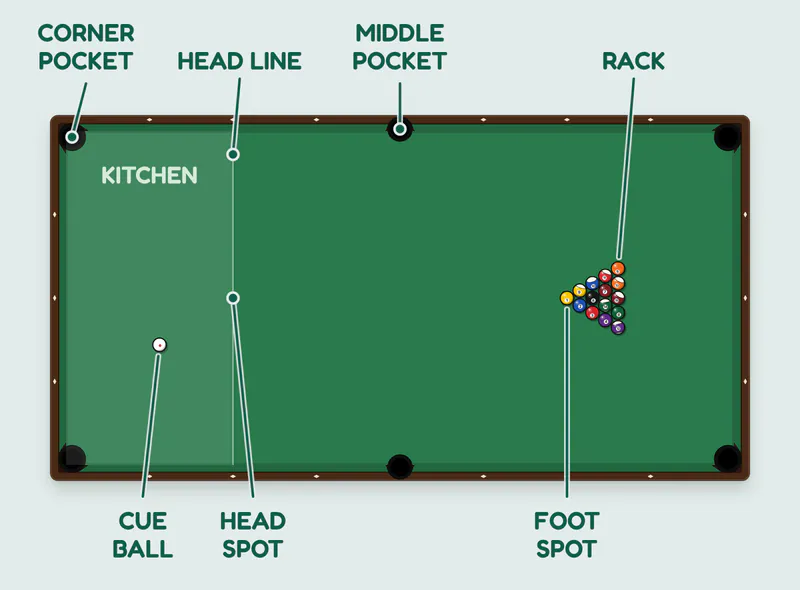
The table ready for the break, seen from above with the head end on the left. The breaker places the cue ball anywhere in the kitchen, behind the head line.
The table has six pockets: one in each corner and one in the middle of each long side. The cloth is surrounded by cushions that the balls bounce off. The head line crosses the cloth a quarter of the way along from the head end, and the area behind it is the kitchen. Two spots are marked: the head spot in the middle of the head line and the foot spot the same distance from the other end.
All sixteen balls are the same size and weight. The solids are one color each, the stripes are white with a band of color, the 8 is black and the cue ball is white (here with small red spots, so you can see it roll). You only ever strike the cue ball.
When the game names a pocket, it does so as seen by a player standing at the head end and looking down the table: the near left and near right corners, the left and right middle pockets, the far left and far right corners. On a phone the table stands upright with the head end at the bottom, so near left is the bottom left pocket on the screen.
The rack and the break
The fifteen balls start in a triangle, the rack, with its front ball, the 1, on the foot spot. The 8 sits in the middle of the third row, and the two back corners hold one solid and one stripe. The game racks the balls for you at the start of every frame.
The first frame is broken by the first player. They have the cue ball in hand behind the head line: they put it anywhere free in the kitchen, and may move it again until they shoot. Then:
- Any ball may be hit first on the break. Hitting nothing at all is a foul.
- A ball in on the break earns another shot, as long as the break was not a foul. It doesn’t decide the groups: the table stays open.
- The 8 in on the break goes back on the foot spot, or on the nearest free place to it, and counts as a ball pocketed, so the breaker shoots again. The break never wins or loses the frame.
- The cue ball in on the break is an ordinary foul: the other player has the cue ball in hand anywhere on the table.
The break wants full power. In a match, players take turns to break, or with Who breaks: Winner (More options) the winner of each frame breaks the next.
The open table, solids and stripes
After the break the table is open: nobody has a group yet, and you may hit any solid or stripe first, but not the 8. The first shot without a foul that pockets balls of only one group gives that group to the shooter and the other group to the opponent. A shot that pockets both a solid and a stripe leaves the table open, and the shooter carries on. Balls that go in on a foul decide nothing.
Step through an open table becoming solids and stripes, and the first foul:
Step through an open table and a foul
Step 1 of 5: After the break the table is open: nobody has a group yet. Ana is to shoot, the cue ball on the left.
Once the groups are set, they stay for the rest of the frame. A ball counts for its group whoever pocketed it: if you pocket one of your opponent’s stripes, it stays down and it is one fewer for them to pocket.
A visit to the table
Each time it is your turn, the rules meet your shot in this order:
- Ball in hand. If you have the cue ball in hand, you place it first. You can place it again, anywhere allowed, until you shoot.
- Calling the pocket. With the option Call the pocket, and the 8 as your ball, you name a pocket before the shot. You can change your mind until you shoot.
- The shot. You aim and shoot. In this game you drag on the table to turn the aim, then pull the power bar at the right of the table down, or press the cue ball or the cue stick and pull back: the cue stick draws back with the pull, and its length is the power. Letting go shoots; letting go where you started cancels.
- Fouls are checked: the cue ball touching nothing, the wrong ball first, the cue ball in a pocket.
- The 8, if it went in, decides the frame (see below).
- Every ball that went in stays down, on a foul too, and counts for its group.
- You shoot again after pocketing one of your own balls without a foul, even if a ball of your opponent’s went in as well. Otherwise the turn passes to the other side.
Fouls and ball in hand
There are three fouls, and the first one that applies is the one the game names:
- The cue ball touches no ball.
- The wrong ball first. The first ball the cue ball touches must be one of your own group. On an open table it may be any solid or stripe, never the 8. Once your seven are down, it must be the 8.
- The cue ball goes into a pocket. This is often called a scratch.
After a foul your turn ends and the next player has the cue ball in hand anywhere: the cue ball comes off the table and they put it on any free spot, not touching a ball and clear of the pockets, before their shot. Balls that went in on the foul stay down, including your own, which still count for you.
Cushions
This version has no cushion rule. A legal shot does not have to send any ball to a cushion after the first contact: if the cue ball touches one of your balls first and nothing goes in, the turn simply passes, with no foul.
Four players: two teams of two
With four players, 8 ball pool is played in two teams of two. In the examples, Ana and Cy are one team and Ben and Dee the other. Play goes round the table in seat order, so the turn always passes from one team to the other:
| In order of play | Team | Partner |
|---|---|---|
| Ana | Team 1 | Cy |
| Ben | Team 2 | Dee |
| Cy | Team 1 | Ana |
| Dee | Team 2 | Ben |
- You shoot again, not your partner. Pocketing one of your team’s balls means another shot for you. Otherwise the other team’s next player shoots.
- A team has one group. The first ball pocketed after the break, without a foul, gives its group to the shooter’s team: “Cy pocketed the 3 ball. Ana and Cy take solids, and Cy shoots again.” From then on, each of you may hit first only a ball of the team’s group, and the 8 once the team’s seven are down.
- A foul hands the table to the other team’s next player, with ball in hand: “Foul: Ben hit the 3 ball first and pocketed the 3 ball for Ana and Cy. Cy has ball in hand.”
- The 8 wins or loses for both partners, by the rules below: “Cy pocketed the 8 ball in the near left corner, so Ana and Cy win the frame.” In a match, frames are counted for the team.
- Who breaks. With Take turns, the break goes round all four seats: Ana breaks frame 1, Ben frame 2, Cy frame 3. With Winner, the player whose shot won the frame breaks the next; when the other team lost it on the 8, the player after the one who lost it breaks.
- Conceding ends the match for the whole team.
Any seat can be the computer, as long as one is a person; the computer plays for its team.
The 8 ball: when it wins and when it loses
The 8 is nobody’s ball until a player has pocketed all seven of their group. From then on it is that player’s only ball: they must hit it first, and pocketing it ends the frame.
You win the frame when you pocket the 8 while it is your ball, the cue ball stays on the table, there is no other foul and, with Call the pocket, it drops in the pocket you called.
You lose the frame when the 8 goes in:
- too early, before your seven were down. That includes pocketing your last ball and the 8 on the same shot: the 8 only became yours if your group was cleared before the shot;
- with the cue ball, on the same shot;
- on a foul, for example after hitting a ball of the other group first;
- in the wrong pocket, with Call the pocket.
If several of these apply, the game names the first one in that order. Try it with one solid left:
Your move: the last ball and the 8
Your last ball and the 8
You are Player 1, playing solids. Your last solid, the blue 2, is near a pocket, and so are the 8 and a stripe. Which ball do you pocket?
Tap the ball you would pocket: the blue 2, the black 8 or the striped 12.
Two endings, in the game’s own words. Ana has solids and all seven are down; Ben still has two stripes. Ana pockets the 8 in the far left corner: “Ana pocketed the 8 ball in the far left corner and wins the frame.” With Call the pocket, Ana calls the far left corner (“Ana called the far left corner for the 8 ball.”), but the 8 drops in the near left corner instead: “Ana pocketed the 8 ball in the near left corner, not the far left corner as called, so Ben wins the frame.”
An open table with no group ball left
It can happen, rarely, that every solid and stripe goes down while the table is still open. Then the 8 is the ball of whoever shoots: hitting it first is legal and pocketing it wins.
Frames and a match
With First to 3 under Match, frames are played until one side has won three. After each frame the next one is racked and starts by itself, broken by the player whose turn it is to break. A player may concede at any time, which ends the whole match.
What this version leaves out
The rules above are the common eight-ball rules, set so that the computer can referee every shot. Compared with tournament play and other house rules, this version:
- has no cushion rule: no ball has to reach a cushion after the first contact;
- has no “two shots” after a foul, a rule from British pub pool: the other player gets the cue ball in hand anywhere instead;
- has no spin: the cue ball is always struck in the middle, so there is no draw, follow or side;
- has no push-outs, jump shots or three-fouls rule;
- only calls the 8, and only with the Call the pocket option: other balls never need a called pocket;
- is for two players or four in two teams: a game for three is not offered.
Glossary
- Ball in hand: the cue ball off the table, to be placed by the player whose turn it is.
- Break: the first shot of a frame, into the rack.
- Cue ball: the white ball, the only one you strike.
- Frame: one game, from the break until the 8 goes in.
- Head line: the line across the cloth near the head end; behind it is the kitchen.
- Open table: the time before groups are decided.
- Rack: the triangle of fifteen balls at the start of a frame.
- Scratch: the cue ball going into a pocket, a foul.
- Solids and stripes: the two groups, 1 to 7 and 9 to 15.
Ready to play? Start a game of 8 Ball Pool. For aiming with the ghost ball, cut shots and where the cue ball stops, read the 8 ball pool tutorial.