Pool rewards a calm eye more than a strong arm. Here you turn the aim first and then pull for the power, so the two things that decide a shot, where you aim and how hard you hit, are choices you make one at a time. This tutorial walks through a first shot, then the skills that win frames: aiming with the ghost ball, cut shots, power, ball in hand, where the cue ball stops, and when the best shot is one that leaves nothing. Try each idea on the 8 Ball Pool table as you read.
What you will learn
- How a shot goes from the aim line to letting go
- How to aim any ball at any pocket with the ghost ball
- How much power a shot needs, and why less is often more
- Where to put the cue ball when you have it in hand
- Where the cue ball stops after a hit, with no spin
- When to play safe, and how each computer level plays
- How to share the table with a partner when four play
If you need the rules first, the 8 ball pool rules guide explains every one. Two reminders that matter below: pocketing one of your own balls earns another shot, and the 8 must wait until your seven are down.
Your first shot, step by step
Start a game with vs Computer at Easy and choose to break first. Leave the Aim guide on: the line it draws ends where the cue ball would first touch a ball, with a circle showing the cue ball at that moment, which takes the guesswork out of aiming while you learn.
Step through a shot: aim, then pull back
Step 1 of 4: Ana has solids and is to shoot. The cue stick lies behind the cue ball, along the aim. Her first idea is to aim at the middle of the blue 2. The line from the cue ball is the aim guide, and its circle shows where the cue ball would touch the 2.
- Break. You have the cue ball in hand behind the head line. Drag it anywhere in that area, aim at the front of the rack, then pull all the way. The break needs full power to spread the balls.
- Pick a ball. Look for one of your group with a clear path to a pocket, and a clear path from the cue ball to it.
- Aim. Drag anywhere on the table to turn the aim line; it stays where you leave it. Check the circle at its end: that is where the cue ball will be when it touches the ball.
- Pull back and let go. Press the cue ball or the cue stick and pull back, or pull the power bar at the right of the table down. The aim does not move, the cue stick draws back, and the longer the pull, the harder the shot. Let go to shoot. Let go where you started and nothing happens.
- Watch where everything stops. The next shot starts from wherever the cue ball ends up.
Aim at the ghost ball
Every shot at a pocket comes down to one picture. Draw an imaginary line from the pocket through the center of the ball you want to pocket, and carry it on behind the ball. Now picture a second cue ball touching your ball on that line, on the side away from the pocket. That imaginary ball is the ghost ball. Send the real cue ball so that its center arrives where the ghost’s center is, and your ball is pushed along the line into the pocket.
When the cue ball, the ball and the pocket are already in one line, the ghost ball sits straight behind the ball and you simply aim at the middle of it: a straight pot. When they are not, you play a cut shot, and the ghost ball is off to one side.
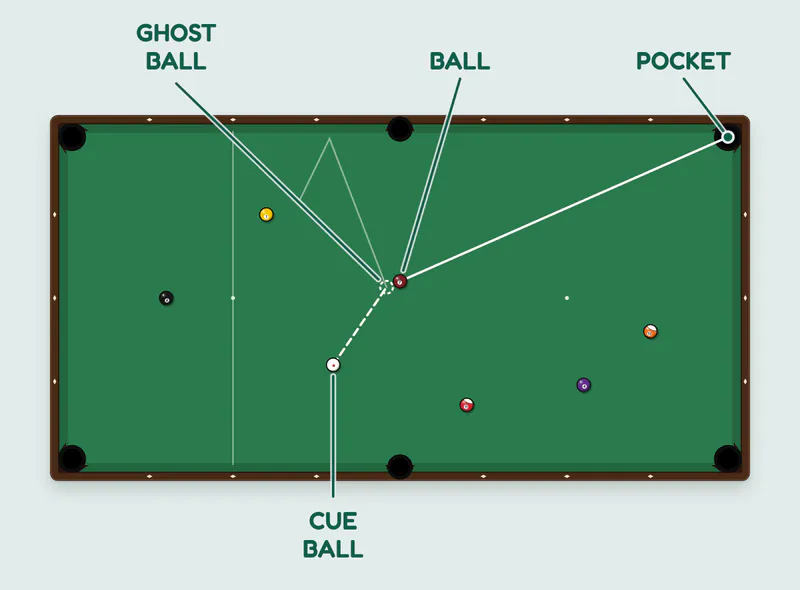
A cut into the top right corner. The cue ball is aimed not at the 7 but at the ghost ball beside it; the 7 leaves along the line from the ghost through its center, and the cue ball rolls off the other way.
- Aim at the ghost, not the ball. On a cut, aiming at the middle of the ball sends it along the line from the cue ball through its center, which misses the pocket. The ghost always looks as if you are aiming a little past the edge of the ball.
- Use the aim guide’s circle. Turn the aim until the circle at the end of the line sits on the spot where the ghost should be.
- Thinner cuts are harder. The farther the ghost is to the side, the less of the cue ball’s speed the ball takes, so the shot needs more power and a small error in aim matters more. Prefer the straighter shot when you have a choice.
Ball in hand: put the cue ball on the line
After the other side fouls, you have the cue ball in hand anywhere. That is the best gift in the game, because you can turn almost any ball into a straight pot. Find the line from the pocket through your ball, carry it on behind the ball, and drag the cue ball onto that line, not too far away. Tap Place, or simply start aiming: aim at the middle of the ball. Until you shoot, Move lets you pick it up again.
Your move: where to put the cue ball
Ball in hand
You are Player 1, playing solids, with the cue ball in hand. From which spot does a shot at the middle of the red 3 send it into the top right corner?
Tap spot A, B or C. Each cue ball is aimed at the middle of the red 3.
Two more things to think about with the cue ball in hand:
- Leave room for the next shot. Put the cue ball where, after this shot, it will roll toward another of your balls rather than into a corner or behind the 8.
- On the break it is only the kitchen. At the start of a frame the cue ball must go behind the head line. Pick a spot there, aim at the front ball of the rack and use full power.
Power: enough, and a little more
The pull runs from a gentle touch to a full shot, and the cue stick shows how far you have gone: it draws back with your finger. Full power is the power bar pulled to the bottom, or a pull on the ball of about two fifths of the table’s short side. As a guide, about a third of a full pull rolls the cue ball around half the length of the table, a little more sends it from the head spot to the far cushion, and a full pull runs two cushions. With a keyboard, W and S set the power in steps. The physics are the same every time, so the same shot from the same position always ends the same way.
- Medium shots are the most accurate. A soft shot can stop short of the pocket; a hard shot makes every small error in aim bigger.
- Hard shots move the cue ball a long way. That makes a scratch more likely and the next position harder to predict.
- Full power is for the break.
Where the cue ball stops
There is no spin in this game: the cue ball is always struck in the middle. That makes position simpler to learn, because only two things decide where the cue ball goes after the hit:
- The angle. On a dead-straight shot the cue ball stops almost where it hits the ball. On a cut it rolls off to the side, close to a right angle to the line the object ball takes, and the thinner the cut, the more speed it keeps.
- The power. The harder the hit, the farther the cue ball travels after it, often off one or two cushions.
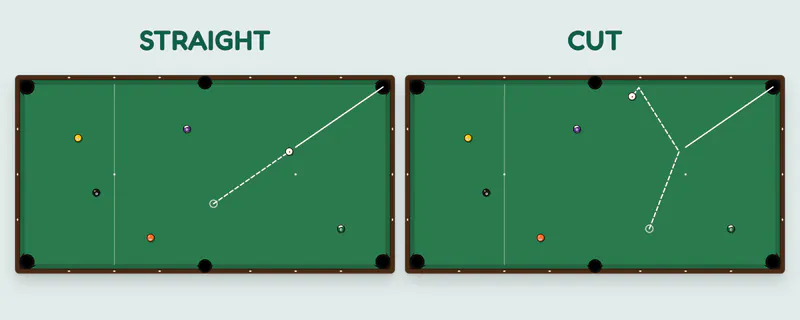
The same red 3 into the same corner, twice. Played straight, the cue ball stops where it meets the 3. Played as a cut, it rolls off to the side and up to the top cushion.
So, before every shot, look at where the cue ball will go next. If the answer is “into a pocket” or “behind the 8”, change the power or pick another ball. A straight pot with medium power is the easiest way to keep the cue ball near the middle of the table.
When to leave nothing
When you have no good shot, a missed shot often hands the other player an easy table. A safe shot is better: touch one of your own balls first, softly, and leave the cue ball where they have nothing easy, far from their balls or behind one of yours. In this version a shot that touches your ball first is legal even if nothing reaches a cushion afterwards, so a gentle touch is a fair safety.
- Count the balls by the pockets. Balls of yours near pockets are chances for later. Balls of theirs near pockets are chances for them: don’t leave the cue ball lined up with them.
- Don’t foul. A foul gives the other player the cue ball in hand anywhere, which is usually worse than any shot you could leave them.
- Plan the 8 early. When you are down to two or three balls, notice where the 8 is and keep a path to a pocket for it. With Call the pocket, pick the pocket before you shoot, and make it the one the aim line points at.
Playing with a partner
With four players you play in two teams of two, and partners take turns at the table: when your turn ends, the other team’s next player shoots, and then your partner. So the table you leave after a miss belongs to the other team’s next player, never to your partner: leave them nothing easy. Agree on a plan for the 8, since you share one group and win or lose the frame together.
Playing the computer at each level
Every level uses the same physics as you do and judges its shots by trying them on a copy of the table first. None of them is perfect: each plays its chosen shot with a small error in aim and power.
- Easy tries a few loosely aimed shots and picks one of its best three. It misses often and never thinks about what it leaves, so it is the place to practice aim and power.
- Medium finds every straight pot it can see and takes the best. Against Medium, the balls you leave by the pockets are the balls it pockets.
- Hard tries many more shots, including ones off a cushion, prefers a sure shot to a thin cut, and looks at where the cue ball stops: a straight pot for itself if its turn goes on, nothing for you if it passes. When nothing is on, it plays safe. To beat Hard, take your chances and avoid fouls: with the cue ball in hand it tries several spots and picks the best.
- Adaptive goes up a step after you beat it and down a step after it beats you, so it settles around your level.
Beginner mistakes
- Aiming at the middle of the ball on a cut. Aim at the ghost ball.
- Too much power. Medium power is more accurate and easier to control.
- Forgetting the cue ball. Every shot ends with the cue ball somewhere: decide where.
- Wasting ball in hand. Put the cue ball on the line from the pocket through your ball.
A practice plan
- Frame 1, Easy, Aim guide on: only take straight pots, and use ball in hand to set them up.
- Frame 2, Easy: play a cut every turn, aiming at the ghost ball, and check it with the aim guide’s circle.
- Frame 3, Medium: before each shot, say where the cue ball will stop, then watch whether it does.
- Frame 4, Medium, First to 3: when nothing is on, play a safe shot instead of a hopeful one.
- Then Hard, and then Aim guide off, once you can picture a ghost ball by eye.
When you are ready, play 8 Ball Pool with a friend on one phone or against the computer.