Rock paper scissors looks like pure luck, and against a perfectly random player it is. The catch is that people are not good at being random. We repeat what worked, we avoid what just failed and we try to “mix it up” in ways that are themselves patterns. This tutorial plays a first game on the site, then goes through the habits that give players away, how each computer level decides, and how to keep your own throws hard to read.
What you will learn
- How a round works on the site, step by step.
- Why no strategy beats a random player, and why that rarely matters.
- Three common habits: keeping a winner, switching after a loss and avoiding repeats.
- How the Easy, Medium and Hard computers pick, and how to play against each.
- What changes when you add lizard and Spock.
Your first game, step by step
- Open Rock Paper Scissors. The setup starts on vs Computer, Medium, Best of 3 and Classic, so you can tap Start game straight away.
- Three big buttons appear: rock, paper and scissors. Tap one, or press R, P or S on a keyboard.
- A quick “rock, paper, scissors” count plays and both hands are revealed. The line under them says which rule decided the round, for example Paper covers rock, and who won it. A tap skips the count.
- The dots next to each name show rounds won. Tap Next round (or press Enter) and pick again.
- The first to win 2 rounds wins the best of 3. Ties don’t count, so a series can take a few extra rounds.
Playing with a friend works the same way, with one difference: each of you picks behind a pass screen, so the other person never sees your pick. The rules guide has the full rules and the five-gesture chart.
Why nobody can beat a random player
The three shapes form a circle. Whatever your opponent throws, one of your options wins, one loses and one ties. If they pick each shape a third of the time with no pattern, every one of your choices wins a third of the time too. There is nothing to aim at.
This is also why the Easy computer on the site picks completely at random. You can’t out-think it and it can’t out-think you: over many rounds you will each win about a third.
People are different. Ask a friend to write down “random” throws and the list tends to switch shapes too often and repeat too rarely. Real randomness repeats a shape three times in a row now and then; people almost never do it on purpose. Those small biases are what strategy works with.
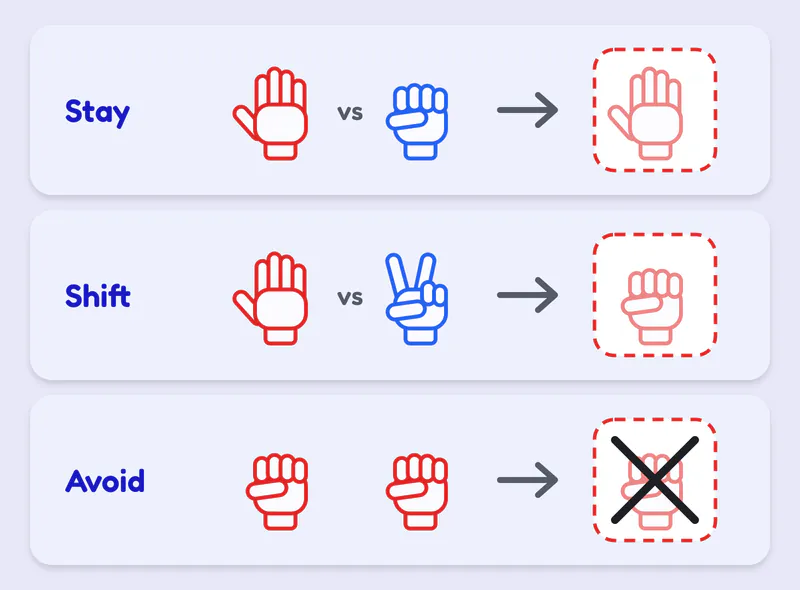
Three habits to watch for. Stay: after their paper beats your rock, a win-stay player throws paper again. Shift: after their paper loses to your scissors, many players move to rock, which would have beaten your scissors. Avoid: after two rocks in a row, a third rock is less likely.
Habit 1: keeping a winner
A player who just won often feels that their shape is “working” and throws it again. This is called win-stay. If your friend’s paper just beat your rock and they are a win-stay player, the next throw is likely paper again, so scissors is the answer.
Watch for it over a few rounds before you trust it. Some people do the opposite and switch after every win because they expect you to adapt.
Habit 2: switching after a loss
The partner of win-stay is lose-shift: after losing, players move to a different shape. Many move to the shape that would have beaten the one that just beat them. If your scissors beat their paper, they may think “rock beats scissors” and throw rock next. Paper would then catch them.
The two habits often come together, and both depend on the result of the last round. That is exactly what the Hard computer on the site tracks.
Step through reading a friend’s habits
Step 1 of 5: Round 1: your friend’s paper beats your rock. They won, and a win-stay player is likely to throw the same again.
Habit 3: avoiding repeats
Even players without win-stay or lose-shift tend to avoid throwing the same shape three times in a row, because it feels too obvious. After two rocks in a row, a player is less likely to throw a third. That doesn’t tell you what they will throw, but it removes one option: if rock is unlikely, then paper is less useful for you, and scissors (which beats paper and loses only to rock) becomes a reasonable choice.
What about the first throw?
A popular piece of advice says many people open with rock because a fist feels strong, so you should open with paper. Treat it as folklore rather than a rule: anyone who has heard the tip may open with scissors to beat your paper. The first round has no history to read, so it is the one throw where you are really guessing. Save your attention for the rounds that follow.
How the computer levels pick
The computer on the site never sees your pick for the current round. It chooses only from the rounds already revealed, the same information you have about it.
- Easy picks at random every time. It is a fair coin with three sides.
- Medium counts the shapes you have played. After three rounds, most of the time it throws whatever beats your favourite shape so far, and otherwise picks at random. If you have thrown rock five times, expect a lot of paper.
- Hard keeps three counts: how often you play each shape, what you tend to play after each shape, and how you change after a win, a loss or a tie. It blends them into a guess for your next throw, plays what beats that guess, and still picks at random about one round in ten so you can’t simply predict it back.
Beating Medium
Medium is easy to steer. Play one shape a few times, say rock, until Medium starts answering with paper. Then throw scissors. When Medium’s count catches up, change your favourite again. You are using its habit against it, which is the whole game in miniature.
Beating Hard
Hard is built to catch exactly the habits above. Your best defence is to be boring in the right way: give it nothing to learn.
- Vary what you do after a win. Sometimes stay, sometimes move up, sometimes move down.
- Vary what you do after a loss, especially if you notice you always shift the same way.
- Avoid little cycles such as rock, paper, scissors, rock, paper, scissors. Hard spots a cycle within a few rounds.
- Think one step ahead, then stop. If you have played a lot of paper, Hard expects paper and throws scissors. Rock beats that answer. But if you do this every time, it becomes a new habit, and Hard learns it too.
Expect to lose some series against Hard even when you play well. Without habits, the best anyone can do is win about as many rounds as they lose.
Playing with five gestures
Lizard and Spock change the numbers. Each shape now beats two and loses to two, and a tie only happens when you both pick the same one of five. The habits still apply, but there are more of them to spot, and one new trick: the gesture that beats two of your opponent’s favourites. If your friend keeps throwing rock and scissors, Spock beats both. If they love paper and Spock, lizard beats both.
Learn the chart before you rely on tricks. In the five-gesture version a wrong guess about what beats what costs more than a misread habit.
Common beginner mistakes
- Trusting one round. One win-stay throw isn’t a pattern. Wait for two or three before you act on it.
- Becoming predictable while hunting patterns. If you always throw what beats your friend’s last shape, a sharp friend will throw what beats that.
- Forgetting ties. In a best of 3 with ties replayed, a tie changes nothing, so don’t let it rattle you.
- Changing strategy every round. Pick a plan for a few rounds, watch what happens, then adjust.
A practice plan
- Play five best-of-3 series against Easy. Notice that nothing you do changes your results much.
- Play against Medium and try to steer it: build up a favourite, then switch to beat its answer.
- Play against Hard and try to stay level over a best of 7. Each time it wins a round, think about which habit it might have caught.
- Play a friend on one phone and watch for win-stay and lose-shift. Tell them about this page afterwards, not before.
When you are ready, play Rock Paper Scissors or read the rules guide for the five-gesture chart and the house rules.