Good logic games for kids are games you win by thinking rather than by luck: working out what’s hidden from clues, planning a move ahead, or spotting a pattern in what the other player does. Code Breaker, Sea Battle, Hangman, Four in a Row and Dots and Boxes are some of the best, and all ten games below are free to play on one phone, tablet or classroom screen, with no sign-up.
The games are grouped by the kind of thinking they practice. Most children enjoy one kind more than the others, so if one game falls flat, try a game from a different group.
What makes a good logic game for kids
- Every result has a reason. In a logic game, a child who loses can usually see why, which is what makes them want to play again and do better.
- The rules are short. The thinking should go into the game, not into remembering the rules.
- Rounds are quick. Five minutes is enough to try an idea, see if it works, and try again.
- There’s a fair opponent. A computer on Easy lets a child practice without a sibling winning every game, and Medium and Hard are there when they’re ready.
Deduction games: work out what’s hidden
1. Code Breaker
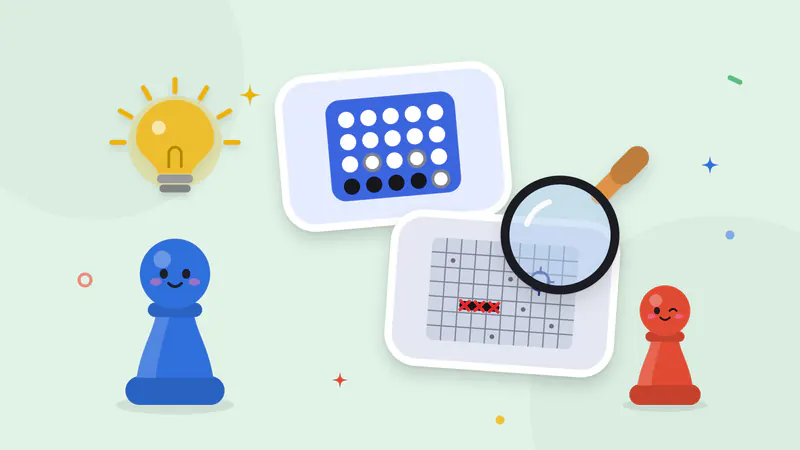
One player hides a secret code of colored pegs and the other tries to crack it. After each guess, the setter gives two clues: how many pegs are the right color in the right place, and how many are the right color but in the wrong place.
Say the secret code is red, blue, green, yellow, and the guess is red, green, blue, purple. That earns one “right place” (the red) and two “right color, wrong place” (the green and the blue). Purple must not be in the code at all, so the next guess can leave it out. That’s deduction in a nutshell: each clue rules things out, and a careful player keeps track of what they know.
Play solo and the computer sets the code, or play with a friend: one sets the code while the other looks away, then you swap. Younger children can start with colors; older ones can try the numbers version, known on paper as Bulls and Cows. Play Code Breaker.
2. Sea Battle
Each player hides a fleet of five ships on a grid, then you take turns calling shots. A hit tells you a ship is there, and the ships around it can only lie in a straight line, across or down. Children quickly learn to stop shooting at random: after a hit, try the squares next to it; before a hit, fire in a checkerboard pattern, because every ship covers at least two squares. Play Sea Battle.
3. Hangman
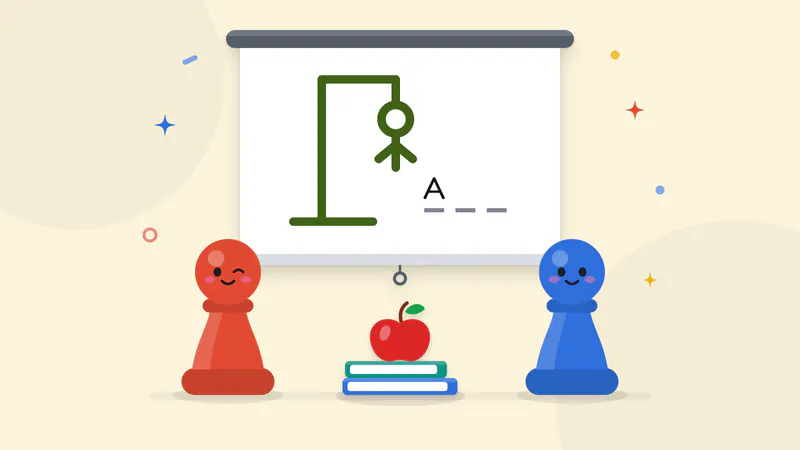
Guess the hidden word one letter at a time. It looks like a spelling game, but it’s also a deduction game: common letters such as E and A are good first guesses, and once a few letters are in place, the word’s shape rules most words out. Teachers can type in this week’s vocabulary words; at home, the computer can pick words from its built-in lists. Play Hangman.
Planning games: think a move ahead
4. Tic-Tac-Toe
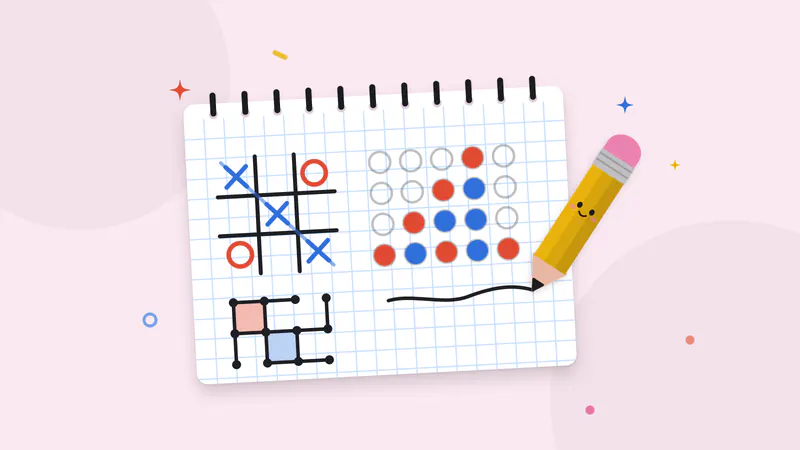
The first strategy game most children learn. The lesson is simple and important: before you play, check whether your opponent is about to make three in a row. With perfect play from both sides it always ends in a draw, which older children can discover for themselves. Play Tic-Tac-Toe.
5. Four in a Row
Drop discs into a grid seven columns wide and six rows tall, and line up four. The board is bigger than Tic-Tac-Toe’s, so children have to look for threats across, down and on both diagonals, and they learn that a disc in the middle column is part of more possible lines than one at the edge. Play Four in a Row.
6. Dots and Boxes
Take turns drawing a line between two dots. Close the fourth side of a box and you claim it and draw again. The key idea, and a lovely one for a child to find, is that drawing the third side of a box hands your opponent a free box, so the game becomes a careful dance of avoiding the third side for as long as possible. Play Dots and Boxes.
7. Ultimate Tic-Tac-Toe
Nine small Tic-Tac-Toe boards inside one big one. Where you play in a small board decides which small board your opponent must play in next. Win three small boards in a row to win. It turns a game children already know into a real planning puzzle, because every move is also a choice about where to send the other player. Play Ultimate Tic-Tac-Toe.
Counting games: numbers with a purpose
8. Mancala
Pick up all the seeds in one of your pits and sow them one at a time around the board. If the last seed lands in your own store, you take another turn. Counting the seeds before moving tells you exactly where you’ll finish, so children practice counting because it wins games, not because they’ve been asked to. The Mancala tutorial explains how to chain extra turns. Play Mancala.
9. Shut the Box
Roll two dice and flip down numbered tiles that add up to the roll: an 8 could close the 8, or 7 and 1, or 5 and 3, or 4, 3 and 1. The choice is the game. Should you close big numbers early, or keep options open? It’s quick addition practice, and a good game for children who are learning their number bonds. Play Shut the Box.
Pattern games: spot what the other player does
10. Rock Paper Scissors
Rock beats scissors, scissors beat paper, paper beats rock. Against a player who picks truly at random, nobody can do better than break even. But people aren’t good at being random: many repeat a gesture that just won, or avoid the one they just played. That makes Rock Paper Scissors a surprisingly good first lesson in patterns and probability.
Play against the computer and watch for this: on Easy it picks at random, but on Hard it learns from the gestures you’ve played and tries to predict your next one. Children who notice they’re losing to it have discovered that they have habits. Can they beat it by changing them? With a friend on one phone, each pick stays hidden until both have chosen. Play Rock Paper Scissors.
For older kids: deeper strategy
Once the games above feel easy, the classic strategy games are waiting. Chess has a computer opponent at three levels and a beginner’s tutorial. Reversi teaches that grabbing the most pieces now isn’t the same as winning, because the lead can swing in the last few moves. Gomoku is five in a row on a big board, where a good player attacks and defends with the same stone.
Logic games at a glance
| Game | Kind of thinking | Suggested age | Players |
|---|---|---|---|
| Tic-Tac-Toe | Blocking, looking ahead | 4+ | 2 |
| Four in a Row | Spotting threats | 5+ | 2 |
| Dots and Boxes | Planning, counting | 5+ | 2 to 4 |
| Rock Paper Scissors | Patterns, chance | 5+ | 2 |
| Mancala | Counting ahead | 7+ | 2 |
| Hangman | Letters, deduction | 6+ | 1 to 4 |
| Shut the Box | Addition, choices | 6+ | 1 to 4 |
| Sea Battle | Search, deduction | 7+ | 2 |
| Code Breaker | Deduction from clues | 7+ (colors), 9+ (numbers) | 1 to 4 |
| Ultimate Tic-Tac-Toe | Planning | 8+ | 2 |
Ages are starting points, not rules. A child who enjoys puzzles may be ready for Code Breaker early; another may want Tic-Tac-Toe for a while longer. Our guide to board games for kids by age has more on matching games to skills.
Logic games on paper
No screen? Several of these started as pencil-and-paper games, and a few more are worth knowing:
- Bulls and Cows. One player writes a secret four-digit number with no repeated digits; the other guesses, and learns how many digits are right and in the right place (“bulls”) and right but in the wrong place (“cows”).
- Nim. Lay out matchsticks or coins in three rows of three, four and five. On your turn, take as many as you like from one row. In one common version, whoever takes the last one wins. The game has a complete mathematical solution, published by the mathematician Charles Bouton in 1901, and older children love trying to find the winning pattern.
- Dots and Boxes and Sea Battle both work on graph paper.
Our pen and paper games post has the rules for twelve classics, including Sprouts, a two-player logic game invented by two mathematicians in 1967.
How to help kids get better at logic games
- Ask “why there?” After a good move, ask how they chose it. Putting a plan into words is half of learning it.
- Think out loud yourself. “If I go here, you could block me there, so I’ll go here instead” shows what planning ahead sounds like.
- Start the computer on Easy. Move up a level once they win most games. Losing every time teaches very little.
- Replay a lost game. In most games Undo takes a move back, so you can return to the turning point and try something else.
- Let them set the puzzle. In Code Breaker with a friend, setting a code and answering guesses correctly is good logic practice too.
- Keep it short. Three quick games beat one long, frustrating one.
Logic games in the classroom
All of these games work on one projector or interactive whiteboard. Split the class into two teams and let each team agree on a move, or play the whole class against the computer and vote. Code Breaker and Sea Battle work especially well as team games, because the clues give the class something concrete to discuss before every guess. Our post on fun games to play in class has a two-minute setup and ideas for turning any game into a review game.
For more picks, see our games for kids collection, or start right away with Code Breaker or Four in a Row.