The best hand games for two need nothing at all: no board, no cards and no phone. Rock, paper, scissors is the classic, and odds and evens, chopsticks, morra, hand cricket, thumb wrestling, red hands and clapping games are all worth knowing. Here are the rules for each, the variations people play, and a few quick two-player games for when you do have a phone in your pocket.
The quick list
| Game | What you do | A round takes | Good for |
|---|---|---|---|
| Rock, paper, scissors | Show a gesture at the same time | Seconds | Deciding who goes first, best-of series |
| Odds and evens | Show fingers, check if the total is odd or even | Seconds | Deciding who goes first |
| Morra | Show fingers and call the total | A minute | Quick sums, fast reactions |
| Chopsticks | Add fingers by tapping hands | 2 to 5 minutes | Math and planning ahead |
| Hand cricket | Bat and bowl with numbers | 5 to 10 minutes | Running scores, cricket fans |
| Thumb wrestling | Pin the other thumb | Under a minute | A quick laugh |
| Red hands | Slap before the other pulls away | A few minutes | Fast reactions |
| Clapping games | Clap a pattern to a rhyme | A few minutes | Rhythm, younger kids |
1. Rock, paper, scissors
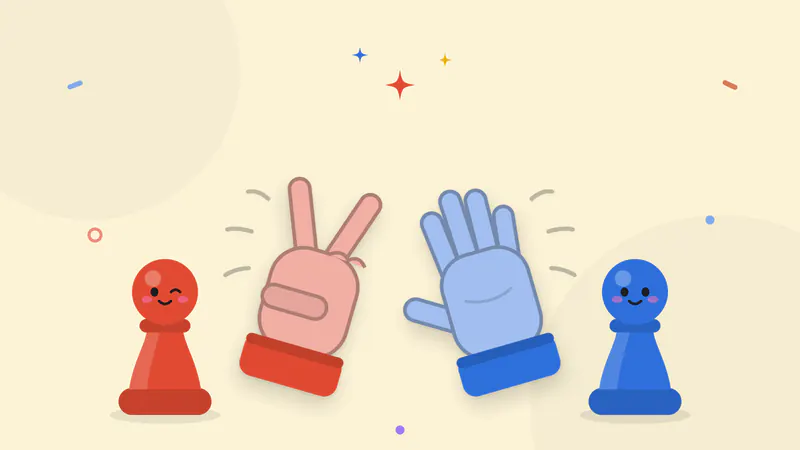
Both players shake a fist, usually to a count of “rock, paper, scissors, shoot”, and on the last word show one of three gestures: a fist for rock, a flat hand for paper, or two fingers for scissors. Rock beats scissors, scissors cut paper, and paper covers rock. The same gesture is a tie, and you play again.
The game goes by many names, including “scissors, paper, stone”, “stone, paper, scissors” and “roshambo”, and hand games like it have been played in East Asia for centuries.
Variations:
- Best of three (or five, or seven): the first to win the majority of rounds takes the series. Ties don’t count.
- Five gestures: add lizard (a hand shaped like a talking puppet) and Spock (the split-finger salute). Each gesture beats two others and loses to two: rock beats scissors and lizard, paper beats rock and Spock, scissors beat paper and lizard, lizard beats paper and Spock, and Spock beats scissors and rock. With five gestures there are fewer ties.
Tip: against a truly random player, no strategy can win more than half the time over many rounds. But people are rarely random. Many players repeat a gesture that just won, or switch after losing, and some open with rock. Watch for habits, and try not to show your own.
On one phone, you can play against a computer that picks at random on Easy and, on Hard, learns from the gestures you’ve played and tries to predict your next one. With a friend, each of you picks in secret and both gestures are revealed together. Play Rock Paper Scissors.
2. Odds and evens
One player is “odds” and the other is “evens.” On a count of three, both show one or two fingers (some people allow anything from none to five). Add the fingers together: if the total is odd, odds wins; if it’s even, evens wins. It takes seconds, which makes it a favorite way to decide who goes first or who picks the team. In India it’s often how a game of hand cricket starts.
3. Morra
Morra is one of the oldest hand games of all. It goes back to ancient Rome and is still played in parts of Italy. Both players throw out one hand at the same moment, showing any number of fingers from none to five, and at the same time shout their guess of the total of both hands. Guess the total exactly and you score a point; if both or neither of you are right, nobody scores. Play to an agreed score, such as five.
It’s fast and loud, and it’s mental arithmetic under pressure: you know your own fingers, so your guess has to be your number plus whatever you think the other player will show.
4. Chopsticks
Chopsticks, sometimes called sticks, is a finger-counting game with real strategy. Each player starts with one finger raised on each hand.
- Tap: on your turn, tap one of your hands against one of your opponent’s. The tapped hand adds the number of fingers on your hand to its own. If your two fingers tap their one finger, their hand now shows three.
- Out: a hand that reaches five fingers or more is out and is put behind your back.
- Split: instead of tapping, you may move fingers between your own hands, for example from three and one to two and two.
- Win: knock out both of your opponent’s hands.
Rules vary from playground to playground. In a popular version, a hand that goes past five wraps around (seven becomes two) instead of going out. Agree on the rules before you start. Chopsticks rewards thinking a move ahead: before you tap, check what your opponent can do to you on their next turn.
5. Hand cricket
Hand cricket is a favorite with children in India and anywhere cricket is loved. After a toss (often odds and evens), one player bats and the other bowls. Each ball, both show a number from one to six at the same time, with the thumb often standing for six.
- If the numbers are different, the batter scores the number they showed.
- If the numbers are the same, the batter is out.
When the batter is out, swap roles. The second batter tries to beat the first score; they win as soon as they pass it, and lose if they’re out before they get there. Playground rules differ on the range of numbers and how many wickets each side gets, so settle those before the first ball.
6. Thumb wrestling
Hook the fingers of your right hands together, thumbs up. Tap thumbs from side to side while you chant “one, two, three, four, I declare a thumb war”, then try to pin the other player’s thumb under yours while they count to three. Keep your elbows on the table and your fingers hooked: no using the other hand.
7. Red hands
One player holds both hands out, palms down, resting lightly on the other player’s palms, which face up. The bottom player tries to flip a hand over and tap the back of the top player’s hand before it pulls away. Miss, and the roles swap. A flinch with no attempt doesn’t count. Agree before you start to keep it to gentle taps, not hard slaps, especially with younger children.
8. Clapping games
Two players face each other and clap a pattern to a rhyme: their own hands, then each other’s right hands, their own hands, each other’s left hands, and so on, getting faster as the rhyme goes on. Traditional rhymes such as “Pat-a-cake” and “Miss Mary Mack” have been passed down in playgrounds for generations. The game is to keep going without losing the rhythm, and to make up new patterns together.
Quick two-player games on one phone
When you have a few more minutes and a phone or tablet, these are just as quick to start, need no sign-up, and work offline once the site has loaded:
- Tic-Tac-Toe: a round takes a minute or two. Play best of five.
- Dots and Boxes: draw lines, close boxes, and try never to draw the third side of a box.
- Four in a Row: drop discs and line up four; about five minutes a game.
- Code Breaker: one of you sets a secret code of colored pegs, the other cracks it from the clues; then swap.
- Hangman: type a secret word, pass the phone, and guess letter by letter.
Each one also has a computer opponent if you’re on your own. For more, our list of games to play when bored sorts ten quick games by how much time you have, and our pen and paper games post has twelve classics for a sheet of paper.
Tips for hand games
- Agree on the rules first. Almost every hand game has local variations, and most arguments start there.
- Count together. Games where you show at the same time only work if nobody’s late. A shared “one, two, three” keeps it fair.
- Play a series. Best of three or first to five makes a single lucky round matter less.
- Keep it gentle. Red hands and thumb wrestling are about speed, not strength.
- Use them to decide things. Who goes first, who chooses the game and who sits by the window: a hand game settles it in seconds, and nobody can say it wasn’t fair.
Next time you need a game with no board, start with Rock Paper Scissors, then try chopsticks for something with a little more thinking.