Crazy eights, also called eights, looks like a game of pure luck: you play what fits and draw when nothing does. But every turn with more than one card that fits is a choice, and those choices add up. Which card you play decides what the next player has to match. Whether you spend an eight now or keep it decides how often you will have to draw later. This tutorial covers the handful of decisions that win hands, then how each computer level plays. For the rules themselves, see the crazy eights rules guide.
What you will learn
- Why your eights are worth keeping, and when to spend them
- Which suit to name, and why your longest suit is usually right
- How to read what the other players can’t follow
- How to leave the next player stuck
- How to cut your losses when playing to 100 points
- What each computer level does, and how to beat it
Hold your eights
An eight is the only card in the pack that always fits. That makes it your insurance: as long as you hold one, you never have to draw. So the first rule is simple: if another card fits, play that one and keep the eight.
There are three good times to spend an eight anyway:
- When nothing else fits. Playing the eight saves you from drawing, which can mean several cards.
- When it wins the hand. An eight can be your last card, and then it names nothing: you are out.
- When it leaves the next player stuck. If you know the next player can’t follow a suit, an eight naming that suit may force them to draw.
The worst use of an eight is to change to a suit for no reason while you still hold a card that fits.
Name the suit you are long in
When you play an eight you name the suit everyone must follow, and the play will usually come back round to you in that suit. Name the suit you hold most of, and you are likely to have an answer when it does. Naming a suit you don’t hold at all only helps the other players.
Your move: which suit to name?
Which suit to name?
You are Player 1. Your only card that fits the seven of diamonds is the eight of hearts. Which suit do you name with it?
Tap the suit you would name.
Two details make this better:
- Eights don’t count when you count your suits: they fit anything anyway.
- Ties go to what you know. If two suits are level, name the one the next player was seen to lack.
Play where you are long
The same idea works without eights. When two cards fit, prefer the one in your longest suit: the suit stays the same, and you keep your options. A card that changes the suit to one you hold little of is a card you may struggle to follow later.
Matching by rank is how you change suit without an eight. Holding the queen of hearts when a queen of spades is on top lets you switch from spades to hearts, which is useful when you are long in hearts or short in spades.
Watch who had to draw
Every draw and every pass tells you something. When a player has to draw, they had no card of the suit to match, no card of that rank and no eight. If the next player just drew on clubs, they probably still have few clubs, so leaving clubs on top, or naming clubs with an eight, may make them draw again.
Watch the hand counts too. The game shows how many cards everyone holds. A player down to one or two cards is close to going out: that is the moment to make life hard for them, even if it costs you an eight.
Leave the next player nothing
Each card you play sets the problem for the next player, not the whole table. With several cards to choose from, ask what each one leaves them: a suit they were seen to lack, a rank already gone, or nothing at all they can follow. With two players this is the whole game; with five, the next player is the one you can affect most, and the others will get their own turns before it comes back to you.
Playing to 100: shed the big cards
In a single hand only going out matters. Playing to 100 points adds a second goal: when someone else goes out, the cards left in your hand become their points. Every eight you are caught holding is worth 50 to them; a king, queen or jack 10; an ace only 1.
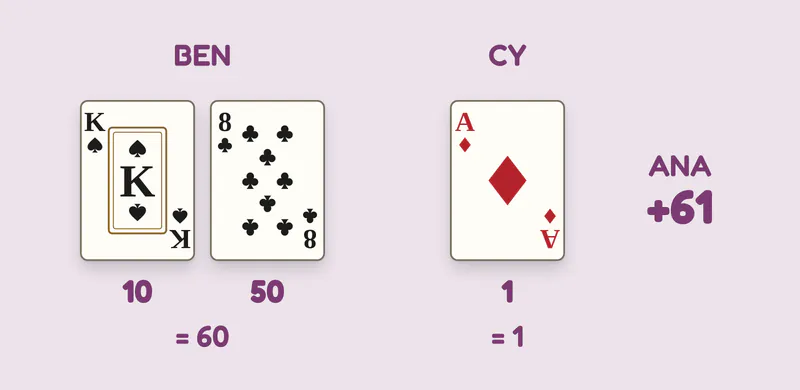
Ana goes out. Ben is caught with the king of spades and the eight of clubs, Cy with the ace of diamonds: 10, 50 and 1, so Ana scores 61.
So, playing to 100:
- Get rid of court cards early when you have a choice between a court card and a small one that both fit.
- Don’t sit on several eights. One eight is insurance; three are 150 points at risk. Spend the spares while they still do something.
- Watch the leader. When someone is close to 100, every hand they win could be the last, so keep them from going out even at the cost of your own score.
Common mistakes
- Spending an eight while a plain card fits. Keep it for when you need it.
- Naming a suit you don’t hold. It helps everyone but you.
- Forgetting what was drawn on. A player who drew on a suit is telling you their weakness.
- Ignoring the next player’s count. One card left is an emergency.
- Holding big cards playing to 100. They are points for whoever goes out.
Playing the computer at each level
Every level plays only from what its own seat can see: its hand, the discard pile, how many cards each player holds, and which suits and ranks each was seen to lack when it had to draw or pass.
- Easy plays a random card that fits and keeps its eights until nothing else fits, then names a random suit it holds. It is a good partner for learning the rules.
- Medium works out, for each card it could play, how likely the next player is to be left with nothing, weighs that more when that player is down to two cards or fewer, keeps its eights and goes where its hand is long. Playing to 100 it sheds high cards first.
- Hard tries each play against many possible deals of the cards it cannot see and picks the one that works out best on average. It is the hardest to keep stuck.
- Adaptive goes up a step after you beat it and down a step after it beats you.
Measured over thousands of hands between computers, Medium wins about 58 hands in 100 against Easy with two players, and Hard about 59 in 100 against Medium. Playing to 100 points, Medium won 77.5 games in 100 against Easy: the longer the game, the more good play counts.
A practice plan
- Game 1, Easy, one hand: keep every eight until you have no other choice, and notice how rarely you draw.
- Game 2, Medium: before naming a suit, count your cards in each suit, eights left out.
- Game 3, Medium, three players: say aloud which suit each player drew on, and use it.
- Game 4, Hard, to 100 points: shed your court cards and spare eights first.
When you are ready, play Crazy Eights against the computer or with friends on one phone.