Crazy eights, also called eights, is a shedding game: every player tries to be the first to get rid of all their cards. One by one, players lay a card on the discard pile that matches the top card by suit or by rank, and eights are wild, playable on anything, with the player naming the suit that has to follow. When nothing fits, you draw. This guide gives the rules exactly as this site plays them, in the order a turn meets them, from the deal to the scoring.
Overview
| Feature | Details |
|---|---|
| Players | 2 to 5 (any seat can be the computer) |
| Cards | One pack of 52, no jokers |
| Deal | 7 cards each with 2 players, 5 each with 3 to 5 |
| Goal | Be the first to play every card in your hand |
| Length | One hand, or to 100 points |
| Typical time | 5 to 15 minutes |
The table
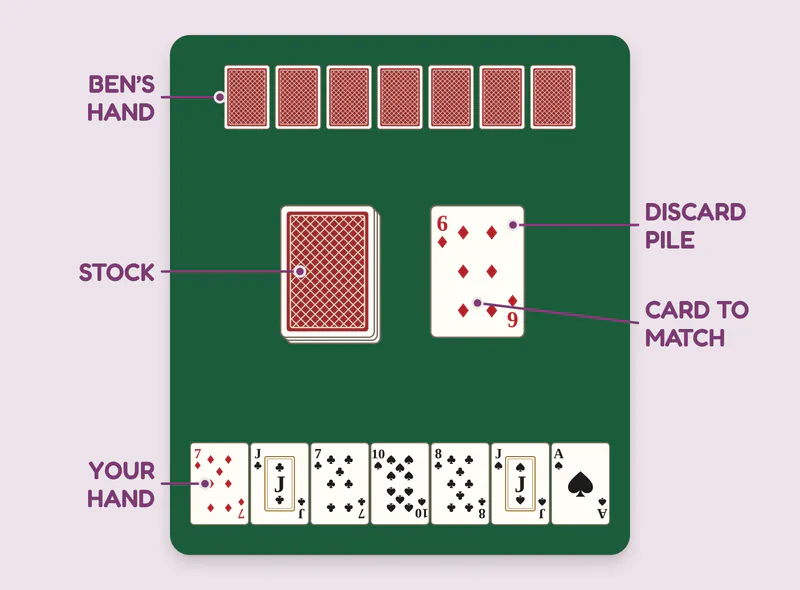
The first turn of a game for two, seen from Ana’s side: Ben’s hand face down, the stock, the discard pile with the card to match on top, and Ana’s hand.
A game uses an ordinary pack of 52 cards, four suits of thirteen: clubs, diamonds, hearts and spades, ranks ace to king. Each player holds a hand that only they see. The rest of the pack lies face down as the stock, the pile you draw from. Next to it is the discard pile, face up: its top card is the card to match.
The deal
Each player gets seven cards with two players and five cards with three, four or five, dealt one at a time round the table. The rest of the pack becomes the stock, and its top card is turned over to start the discard pile.
If that first card is an eight, it goes back into the middle of the stock and the next card is turned over instead, so nobody has to name a suit before the first turn. In the first hand the setup decides who plays first; playing to 100, the next player round the table starts each new hand.
What you can play
On your turn you play one card onto the discard pile. It must:
- be of the suit to match, normally the top card’s suit; or
- be of the same rank as the top card (a seven on a seven, a queen on a queen); or
- be an eight, which goes on anything.
You must play if you can. Drawing is only allowed when nothing in your hand fits.
Your move: what can you play?
What can you play?
You are Player 1, and the six of diamonds is on the discard pile. Which of your cards can you play?
Tap a card in your hand to see whether it fits.
Eights are wild
An eight can be played on any card, and the player who plays it names a suit: clubs, diamonds, hearts or spades. The next player must then play a card of the named suit or another eight. After an eight, the eight’s own suit no longer counts, and nor does its rank, except that another eight is always allowed.
You can name any suit, including one you don’t hold, though it is rarely wise. An eight can also be your last card: then it names nothing, because nobody plays after it, and you win the hand.
Step through a few turns of one real game for two, seen from Ana’s side:
Step through a few turns
Step 1 of 5: A game for two, seen from Ana’s side. The six of diamonds starts the discard pile, and Ana plays first.
When you can’t play
If no card in your hand fits, you draw from the stock, and here the game does the drawing for you. There are two ways, set under Can’t play in the setup:
- Draw until you can (the default). Cards come off the stock until one fits, all in one go, and that card is played at once. If it is an eight, you choose the suit. Only you see which cards you drew; the table hears how many.
- Draw one. You draw one card. If it fits, you may play it, or keep it and pass. If it doesn’t fit, you pass.
You never draw while a card in your hand fits.
When the stock runs out
If the stock runs out in the middle of a draw, the discard pile, all but its top card, is shuffled to make a new stock, and drawing goes on. This can happen at most three times in a hand. After the third time, once the stock is empty, a player who can’t play simply passes.
The limit is there because a hand could otherwise go round forever, with players naming suits the others lack and drawing the same cards back again. Three is easy to remember.
A blocked hand
If nobody can play and nothing can be drawn, the hand is blocked and ends at once. That can only happen after the third reshuffle, because before then every card not on the pile is in someone’s hand or the stock.
- A single hand: the player with the fewest cards wins. If the fewest cards tie, the lower count of points wins; if that ties too, the hand is a draw.
- Playing to 100: the player with the lowest count of points in hand wins the hand and scores the difference between their count and each other player’s. If the lowest counts tie, nobody scores.
Going out and scoring
The first player to play their last card goes out and wins the hand.
With One hand, the default, that is the game. With 100 points, set under Play to, the winner of each hand scores the cards left in every other hand:
| Card | Points |
|---|---|
| Eight | 50 |
| King, queen, jack | 10 |
| Ace | 1 |
| Two to ten | Their number |
The first player to reach 100 points wins the game. Only a hand’s winner scores, so two players can never reach 100 together. Between hands, every hand is shown face up so everyone can check the count, and a person taps Next.
For example, with Ana on 30, Ben on 10 and Cy on 5, Ana plays her last card. Ben is left with the king of spades and the eight of clubs (10 + 50) and Cy with the ace of diamonds (1). The game says: “Ana played the five of hearts. Ana is out and scores 61 points. Scores: Ana 91, Ben 10, Cy 5.”
Two players, or more
The rules are the same for two to five players. With two, each player starts with seven cards and every suit you name is aimed at the one opponent; with more, each starts with five, play goes round the table, and the suit you name is a problem for the next player first.
With more than one person at the table, each hand stays private. Between turns a pass screen asks the next player to take the phone and tap to show their own cards; no hand is drawn behind it. Forced moves, a draw or a pass, happen without the phone changing hands, so nobody learns another player’s cards from watching.
Fine points that settle arguments
- One card a turn. You play exactly one card, even if you hold another of the same rank. Laying down several cards at once belongs to other games.
- Naming the eight’s own suit. You may name any of the four suits, the eight’s own included. Playing the eight of hearts and naming hearts is allowed; it simply keeps hearts as the suit to match.
- An eight from the stock. With Draw until you can, an eight counts as a card that fits, so drawing stops there and you play it and name a suit, just as if you had held it.
- A kept card is not announced. With Draw one, if you keep a card that fits, the table only hears that you passed, exactly as when nothing fitted. Nobody learns that you are holding a playable card.
- What everyone may know. How many cards each player holds and how many are left in the stock are public; the cards themselves are not. Only the player who drew learns which cards came off the stock.
- The suit to match after an eight. The named suit stays in force until the next card is played on the eight, whoever is next. A player who can’t follow it, and has no eight, draws.
- When the first card turned up is an eight. It goes back into the stock before the first turn, so no player starts with a suit already named.
What this version leaves out
Families play crazy eights with many small differences. This version plays the common rules above and leaves out:
- Special cards that skip a player, reverse the order or make the next player draw; only eights are special here.
- Drawing when you could play, allowed in some homes: here you must play if you can.
- A limit on draws other than the three reshuffles: with Draw until you can, you draw until a card fits.
- Saying “last card” and penalties for forgetting: the game shows how many cards everyone holds.
Glossary
- Card to match: the top card of the discard pile, or the suit named with an eight.
- Discard pile: the face-up pile the cards are played onto.
- Go out: play your last card.
- Stock: the face-down pile you draw from.
- Suit: clubs, diamonds, hearts or spades.
Ready to play? Start a game of Crazy Eights. For when to play your eights and how to keep the others stuck, read the crazy eights strategy tutorial.