Hot Dice is a push-your-luck game for two or more players with six dice. Each turn you roll, set aside the dice that score and decide whether to bank your points or risk them on another roll. It goes by several names, including Ten Thousand, 10,000 and Zilch, because the usual target is 10,000 points, so if you learned the ten thousand dice game or the zilch dice game rules at home, most of this will look familiar. This guide gives the full rules used on this site, the scoring table, how busts and hot dice work, the optional opening score and the final round, plus the house rules you are likely to meet at other tables.
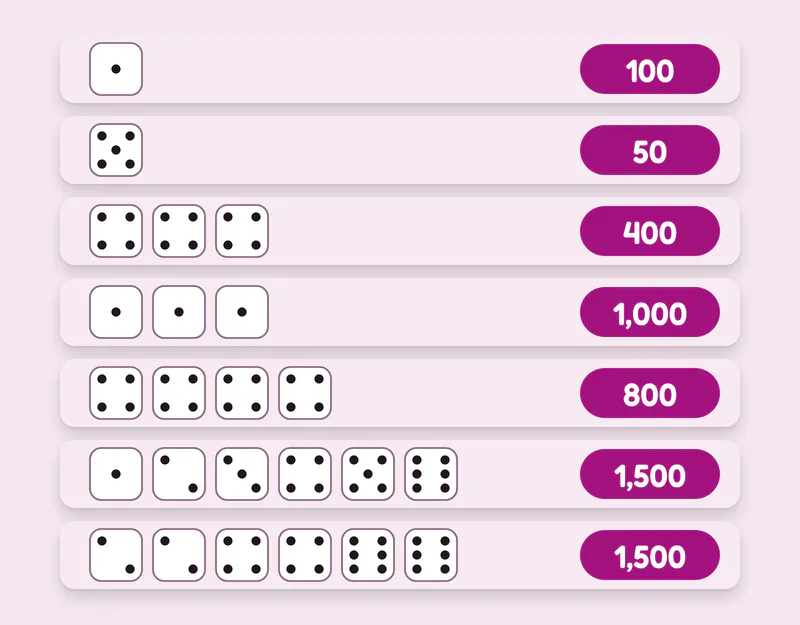
What the dice of one roll score: a single 1 is 100 and a single 5 is 50, three 4s are 400 and three 1s 1,000, four 4s are 800 (double three), and a straight or three pairs is 1,500.
Overview
- Players: 2 to 6 on this site, each a person or a computer player.
- Equipment: six standard dice and a score sheet. Here both are built in.
- Time: about 20 to 40 minutes for a game to 10,000, depending on the number of players.
- Goal: have the highest total when the game ends. The first player to bank 10,000 points starts the final round.
- Skills: quick counting, reading the odds and knowing when to stop.
Setting up
Everyone starts on 0. Choose who goes first; the turn then passes around the table in order. On this site you pick the number of players, set each seat to a person or the computer, and choose the opening score (None or 500) before you start. Rematches start with the next player, so the first turn moves around the table from game to game.
Objective
Score points by rolling combinations and banking them before a bad roll wipes them out. Your score only grows when you bank, so the whole game is a series of small bets: one more roll could add hundreds of points, or lose everything you collected this turn.
How a turn works
- Roll all six dice.
- Set aside at least one scoring die or combination from that roll. You choose which scorers to keep; you don’t have to keep them all.
- Choose: bank the turn’s points, or roll the dice that are left.
- Keep going for as long as you like. After every roll you must set aside at least one more scoring die before you can roll again or bank.
- Bust: if a roll has no scoring dice at all, the turn ends and every point collected in it is lost.
- Hot dice: if all six dice have been set aside, you may roll all six again and keep adding to the same turn.
- Bank whenever you have set aside at least one scorer from the latest roll. The turn’s points go on your score and the dice pass to the next player.
Points from different turns never mix: a bust only costs the points of the turn in which it happens, never your banked score.
Step through a turn
Step 1 of 5: Roll all six dice: 1, 5, 2, 2, 3 and 6. Only the 1 and the 5 can score; the 2s, the 3 and the 6 can’t be kept.
Scoring
Only dice set aside from the same roll can form a combination. This is the 10000 dice game scoring used on this site:
| Dice from one roll | Points |
|---|---|
| Single 1 | 100 |
| Single 5 | 50 |
| Three 1s | 1,000 |
| Three 2s / 3s / 4s / 5s / 6s | 200 / 300 / 400 / 500 / 600 |
| Four of a kind | 2 × the three of a kind (four 2s: 400, four 1s: 2,000) |
| Five of a kind | 4 × the three of a kind (five 2s: 800, five 1s: 4,000) |
| Six of a kind | 8 × the three of a kind (six 2s: 1,600, six 1s: 8,000) |
| Straight 1, 2, 3, 4, 5, 6 | 1,500 |
| Three different pairs | 1,500 |
Twos, threes, fours and sixes score nothing on their own. They only count as part of three or more of a kind, a straight or three pairs. A 1 or a 5 that is part of a set scores as part of the set, not on its own as well.
Scoring examples
- 1, 1, 5, 3, 4, 6. You can keep a single 1 (100), both 1s (200), the 5 (50), or all three scorers (250). The 3, 4 and 6 can’t be kept.
- 2, 2, 2, 1, 4, 6. Three 2s are 200; with the 1 that is 300. You could also keep just the 1 and roll five dice.
- 4, 4, 4, 4, 5, 2. Four 4s are 800 (twice the 400 for three 4s). With the 5 it is 850.
- 3, 3, 5, 5, 6, 6. Three pairs: 1,500, and all six dice have scored, so you have hot dice.
- 1, 2, 3, 4, 5, 6. A straight: 1,500 and hot dice. Read as singles, the same roll would be only 150.
- 2, 2, 2, 3, 3, 3. Two sets of three: 200 + 300 = 500, and hot dice.
When a roll can be read in more than one way, you choose how to keep it, and the higher reading counts. On this site the dice you tap are scored at their best value automatically.
Tap the dice to check a score
Tap a die to change it (or use ↑ ↓ and 1–6).
Dice: 1, 1, 5, 3, 4 and 6.
250points
- Two 1s 200
- A 5 50
The 3, the 4 and the 6 don’t score.
Busts
A roll busts when none of the dice you just rolled can score. With one die that means anything but a 1 or a 5; with six dice it means no 1, no 5, no three of a kind, no straight and no three pairs. The dice you set aside earlier in the turn don’t help: only the dice you rolled count. When you bust, your turn ends immediately and you lose all the points you collected in it. Your banked score doesn’t change.
Busts are the heart of the game. The fewer dice you roll, the more likely they are: one die busts two times in three. The Hot Dice strategy tutorial has the exact odds for one to six dice.
Hot dice
If every one of the six dice has scored during the turn, you have hot dice. You may pick up all six and roll them again, carrying the turn’s points forward. You can also bank instead. A turn can have hot dice several times; there is no limit as long as you keep scoring. A straight or three pairs on the first roll gives you hot dice at once, and so does keeping your last die when it rolls a 1 or a 5.
The opening score
Many tables require a minimum first bank, often called getting on the board. On this site the opening score is an option:
- None: any bank counts from your first turn.
- 500: your first bank must be at least 500 points in a single turn. Until you reach it you can’t bank: you must keep rolling until you get to 500 or bust. Once you are on the board, every later bank counts, however small.
The opening score slows the start of the game a little and makes the early turns more dramatic.
The final round and winning
The first player whose bank brings them to 10,000 or more starts the final round. Every other player then gets exactly one more turn, in order. The player who reached 10,000 doesn’t play again. After the last of those turns, the player with the highest total wins, even if it isn’t the one who reached 10,000 first. Players on the same top score share the win.
In the final round, banking only makes sense if it puts you ahead of the leader (or level with them for a shared win), so players who are behind keep rolling until they get there or bust.
Undo on this site
Undo can take back a bank until a person rolls again (a computer turn in between doesn’t count). You get the same dice back and can roll on instead. Undo never takes back a roll and never gives you different dice, so a bust can’t be undone.
Variants and house rules
The game is played in many homes with small differences. The common ones:
- Different values for sets. Some tables score four, five and six of a kind as flat amounts (1,000, 2,000 and 3,000) instead of doubling.
- Three pairs and straights. Some give three pairs 750 or 1,000, or count four of a kind plus a pair as three pairs. Some also score a short straight of five dice.
- Different opening scores. 350, 500 and 1,000 are all common minimum first banks.
- Bust penalties. Some tables take points off a player who busts three turns in a row.
- Exact finish. A few tables require exactly 10,000, or a different target such as 5,000 for a shorter game.
On this site the values are the ones in the table above, the target is 10,000, and the opening score is None or 500. If you play at a real table, agree on the house rules before the first roll.
Common mistakes and rule disputes
- Mixing rolls. A pair of 5s from one roll and a third 5 from the next are not three of a kind.
- Keeping non-scorers. You can’t set aside a 2, 3, 4 or 6 unless it is part of a set, a straight or three pairs.
- Rolling without keeping. Every roll must be followed by keeping at least one scorer before you roll again or bank.
- Counting set-aside dice in a bust. Only the dice just rolled decide a bust.
- Forgetting the final round. Reaching 10,000 doesn’t end the game on the spot; everyone else gets one more turn.
Glossary
- Bank: end your turn and add its points to your score.
- Bust: a roll with no scoring dice; the turn scores 0. Also called a zilch.
- Hot dice: all six dice have scored, so all six can be rolled again.
- On the board: a player who has made their first bank (matters with an opening score).
- Set aside: keep scoring dice out of the next roll.
- Turn total: the points collected so far this turn, not yet banked.
Play it now
You can play Hot Dice right now with friends on one device or against the computer. If you like dice games, Yacht Dice is a five-dice scorecard game where you plan a whole card instead of a single turn, and the dice games and family games collections have more.