Liar’s Dice is a bluffing game played with five dice per player. Everyone rolls in secret, then players take turns making bids about all the dice on the table, each bid higher than the one before, until someone thinks the latest bid is false and calls “Liar!”. Every die is then shown and counted, and whoever was wrong loses a die. Lose all your dice and you are out; the last player with dice wins. This guide explains how to play Liar’s Dice step by step: setting up, bidding and raising, wild ones, calling Liar, counting the dice, losing dice and winning. These are exactly the rules the Liar’s Dice game on this site uses.
Overview
| Players | 2 to 6 |
| Equipment | 5 dice per player (this site also offers 3 or 4), something to hide them |
| Time | 10 to 20 minutes |
| Goal | Be the last player with dice |
| Skills | Probability, reading other players, bluffing |
Liar’s Dice works because nobody knows the whole picture. You see your own five dice and nothing else, yet every bid is about all the dice in play. A bid of “six 4s” at a table of four players is a claim about twenty dice. Some of that claim you can check against your own hand; the rest is a guess, or a bluff.
What you need
At a real table each player needs five ordinary six-sided dice and a cup or a hand to roll them under, so that nobody else can see them. On this site the dice are rolled for you, and with two or more people on one device a pass screen hides everything between turns. Against the computer your own dice are simply always on screen.
Setting up
- Choose the number of players, from 2 to 6. On this site each seat can be a person or a computer player.
- Give every player the same number of dice: 5 in the standard game, or 3 or 4 for a shorter game.
- Decide whether ones are wild. They are by default; the setup has a Wild ones switch.
- Decide who starts the first round. After that the starting player follows the results, as explained below.
Objective
Keep your dice. You lose a die every time you lose a challenge, and you are out when your last die is gone. The last player who still has dice wins the game, and the others are ranked by how long they lasted: the player who went out last comes second, and so on.
How a round works
Everyone rolls
At the start of every round, every player still in the game rolls all of their dice in secret and looks at them. Nobody shows their dice until the round ends with a call of Liar.
The opening bid
The first player of the round must make a bid. A bid has two parts: a quantity and a face. “Three 4s” means: among all the dice in play, at least three show a 4. You may bid on a face you don’t hold at all, and the quantity can be anything from one up to the number of dice in play. Nobody can call Liar before this first bid.
Raising the bid
Play goes clockwise. On your turn you have exactly two choices: make a higher bid, or call “Liar!” on the bid just made. A higher bid is either:
- more dice of any face: after three 4s you may bid four 2s, four 6s or five of anything; or
- the same number of dice of a higher face: after three 4s you may bid three 5s or three 6s.
Lower bids, equal bids and the same quantity of a lower face are not allowed. After three 4s you may not bid three 3s or two 6s.
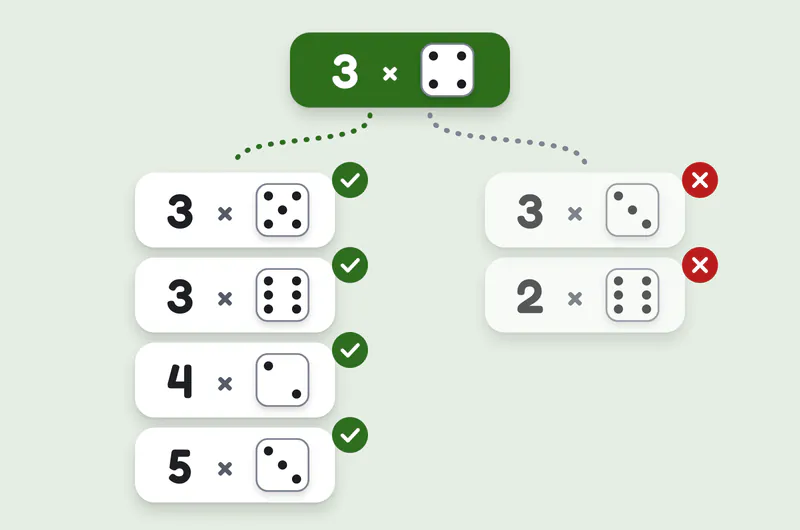
After a bid of three 4s: three 5s and three 6s are higher (same number, higher face), and so are four 2s and five 3s (more dice). Three 3s and two 6s are not.
The quantity can never be more than the number of dice in play. If the bid reaches the top, the full number of dice showing 6s, no higher bid exists and the next player’s only choice is to call Liar.
Calling Liar
If you think the last bid is too high, call “Liar!” instead of bidding. The round stops there: everyone shows their dice and they are counted.
Wild ones
With wild ones, which this site uses unless you switch them off, every 1 counts as the face that was bid. If the bid was five 3s, every 3 and every 1 on the table counts toward it. Because a 1 already counts as everything, nobody may bid on 1s, and the faces you can bid on are 2 to 6.
With Wild ones switched off, a 1 is just a 1. It counts only toward a bid on 1s, and 1s become an ordinary face that you can bid on: the lowest face, so three 1s is below three 2s.
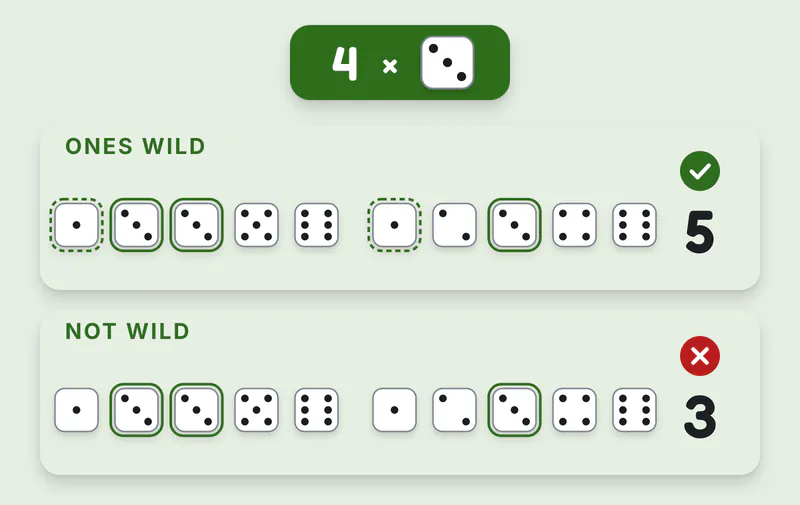
The same two hands and a bid of four 3s. With ones wild, the three 3s and the two 1s count: five dice, so the bid is true. Without wild ones only the three 3s count, and the bid fails.
Counting the dice
After a call of Liar, count every die on the table that shows the bid face, plus every 1 when ones are wild.
- If the count is at least the quantity bid, the bid was true. The player who called Liar loses one die.
- If the count is less than the quantity bid, the bid was false. The player who made the bid loses one die.
An exact count, the same number as the bid, means the bid was true. A bid always means “at least this many”, never “exactly this many”.
A worked example
Three players, five dice each, ones wild.
- Maya rolls 1, 4, 4, 5, 6.
- Leo rolls 2, 3, 4, 6, 6.
- Ana rolls 1, 1, 3, 5, 5.
Maya opens with “three 4s”. She holds two 4s and a 1 herself, so the bid is already true. Leo raises to “four 4s”, hoping. Ana holds no 4s but two 1s, so she raises to “four 5s”: her own two 5s and two 1s make that true by themselves. Maya bids “five 5s”: she has one 5 and one 1. Leo, holding no 5s and no 1s, calls “Liar!”.
Everyone shows their dice. The 5s and 1s are: Maya’s 1 and 5, Ana’s two 1s and two 5s. That is six dice, more than the five Maya bid. The bid stands, so Leo, the player who called, loses a die. Leo will start the next round with four dice.
Step through the example
Step 1 of 5: Three players, five dice each, ones wild. Each player has rolled in secret; here you can see every hand.
Losing dice and going out
The player who loses a challenge puts one die aside for the rest of the game. Every player then rolls again for the next round, with however many dice they now have, and the total number of dice in play goes down by one each round.
The player who lost a die starts the next round. If that was their last die, they are out, and the next player still in the game, going clockwise, starts instead. Players who are out are skipped for the rest of the game.
Winning the game
The game ends when only one player has dice left. That player wins. Everyone else is ranked by the order in which they went out: the last player to go out is second, the one before that is third.
Playing on one device
On this site the game takes care of the secrecy. With two or more people, every person’s turn begins with a pass screen that covers the table and says who should take the device next, along with the last bid. Only after that person taps their name do their dice appear, with everyone’s dice counts and the bids of the round. Computer turns never ask for the device. When someone calls Liar, every hand is shown to everyone, which is how the game is played at a real table too.
Undo takes back only your own bid in the current round. It is never offered once a call of Liar has shown the dice, and never when it would show another person’s dice.
Variants and house rules
Liar’s Dice is an old game with many local rules. These are common ones that this site does not use, so agree on them first if you play at a table:
- Exact or spot-on call. A player may claim the last bid is exactly right; if it is, they win back a die or everyone else loses one, and if not, they lose a die.
- Bidding on 1s with wild ones. Some tables let you switch to 1s by halving the quantity, or switch back by doubling it.
- Last-die rounds. When a player is down to one die, some tables play a special round in which ones are not wild or the face can’t change.
- Everyone loses the difference. In some versions the loser gives up as many dice as the bid was wrong by, not one.
The game here keeps to the simple core: raise or call, one die lost per challenge, and an optional wild-ones rule.
Common mistakes and rule disputes
- Counting only your own dice. A bid is about every die in play, not just yours.
- Forgetting the 1s. With wild ones, the 1s count for every face. Count them at the reveal and when you work out a bid.
- Thinking an exact count loses. A bid means at least that many. Exactly that many means the bid was true.
- Raising with a lower face at the same quantity. Four 5s can’t be followed by four 3s. Go up a face or up a die.
- Calling Liar before the first bid. The first player of a round has to bid.
Glossary
- Bid: a quantity and a face, a claim that at least that many dice in play show that face.
- Raise: a higher bid, with more dice or the same number of dice of a higher face.
- Liar: the call that ends a round and makes everyone show their dice.
- Wild ones: the rule that every 1 counts as the face being bid.
- Dice in play: all the dice that every player still in the game holds this round.
- Out: a player with no dice left.
Play it now
Ready to try? Play Liar’s Dice free on this site against the computer or with friends on one device. Then read the Liar’s Dice strategy tutorial to learn when to call Liar, how to use the odds and when a bluff pays. For more games of chance and nerve, see the Yacht Dice rules or browse all the dice games.