In the 10,000 dice game, each 1 scores 100, each 5 scores 50, three of a kind scores 100 times the number (three 1s score 1,000), and a straight or three pairs scores 1,500. That one sentence covers most rolls, but the edge cases are where arguments start: four of a kind, dice kept from two different rolls, and whether four 2s and a pair of 3s count as three pairs. Below is the full 10,000 dice game scoring chart, exactly as our Hot Dice game scores it, with how often each combination turns up, the house rules other tables use, and a score sheet you can copy or print.
The game goes by several names, including Ten Thousand, 10,000, Zilch and Hot Dice. The scoring below is the classic six-dice table, so zilch scoring and ten thousand scoring at most kitchen tables will look very close to it. If you need the turn rules first, the Hot Dice rules guide explains rolling, setting dice aside, busts and the final round.
The scoring chart
These are the scores for dice set aside from one roll. Twos, threes, fours and sixes score nothing on their own; they only count as part of a set, a straight or three pairs.
| Dice from one roll | Points |
|---|---|
| A single 1 | 100 |
| A single 5 | 50 |
| Three of a kind | 100 × the number (three 4s = 400) |
| Three 1s | 1,000 |
| Four of a kind | 2 × the three of a kind |
| Five of a kind | 4 × the three of a kind |
| Six of a kind | 8 × the three of a kind |
| Straight: 1, 2, 3, 4, 5, 6 | 1,500 |
| Three different pairs | 1,500 |
| Two sets of three | Both sets added together |
Three rules decide almost every disputed score:
- One roll only. A combination counts only if all its dice came from the same roll. Two 5s kept after one roll and a third 5 from the next roll are three single 5s, worth 150, not 500.
- Only scoring dice can be set aside. You may keep any scoring die or set, but never a lone 2, 3, 4 or 6.
- Each die scores once, at its best reading. A 1 inside three 1s is part of the 1,000, not an extra 100. When a roll can be read two ways, the higher reading counts: 1, 1, 5, 5, 3, 3 is three pairs for 1,500, not 300 in singles.
Sets of three or more, face by face
Each die beyond three doubles the set, so big sets grow fast. This is the whole table for every face:
| Face | Three | Four | Five | Six |
|---|---|---|---|---|
| 1s | 1,000 | 2,000 | 4,000 | 8,000 |
| 2s | 200 | 400 | 800 | 1,600 |
| 3s | 300 | 600 | 1,200 | 2,400 |
| 4s | 400 | 800 | 1,600 | 3,200 |
| 5s | 500 | 1,000 | 2,000 | 4,000 |
| 6s | 600 | 1,200 | 2,400 | 4,800 |
Notice that three 1s are worth more than three 6s, and four 1s alone are worth 2,000. That is why a pair of 1s is exciting to roll alongside four other dice: a third 1 on the same roll would turn 200 into 1,000.
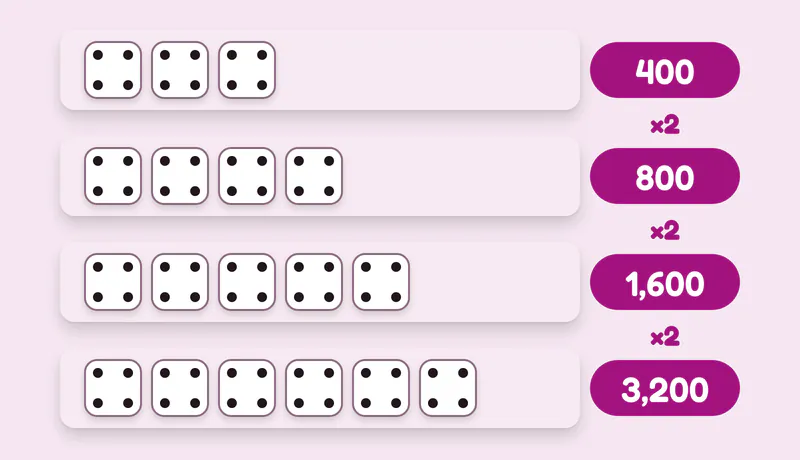
Three 4s score 400, and every die over three doubles the set: four 4s 800, five 1,600, six 3,200.
How often each combination comes up
Scores are higher for rarer rolls, and it helps to know just how rare they are. These are the exact chances for one roll of all six dice, counted over all 46,656 possible results:
| Roll of six dice | Chance | Roughly |
|---|---|---|
| At least one 1 or 5 | 91.2% | 9 in 10 |
| Three or more of a kind (any face) | 36.7% | 3 in 8 |
| Four or more of a kind | 5.2% | 1 in 19 |
| Three different pairs | 3.9% | 1 in 26 |
| No scoring dice at all (a bust) | 2.3% | 1 in 43 |
| Straight 1 to 6 | 1.5% | 1 in 65 |
| Two sets of three | 0.6% | 1 in 156 |
| Five or more of a kind | 0.4% | 1 in 251 |
| Six of a kind | 0.01% | 1 in 7,776 |
Two things stand out. First, a bust on six dice is rare, so your opening roll of a turn is almost free. The danger grows as you set dice aside, and the Hot Dice strategy tutorial has the bust odds for one to six dice and the turn totals worth banking with each. Second, three pairs are rarer than four of a kind, yet four 2s score only 400. That gap is one reason so many families change the value of sets, as you will see below.
Scoring examples
Here are a few rolls of six dice and their best score:
- 1, 1, 1, 5, 2, 3: three 1s (1,000) plus the 5 (50) = 1,050.
- 5, 5, 5, 5, 1, 3: four 5s (1,000) plus the 1 (100) = 1,100.
- 4, 4, 4, 4, 2, 2: four 4s = 800. The two 2s score nothing; four of a kind plus a pair is not three pairs.
- 2, 3, 4, 5, 6, 6: no straight, so only the 5 scores: 50.
- 6, 6, 6, 6, 6, 6: six 6s = 4,800 and hot dice.
- 3, 3, 3, 6, 6, 6: two sets of three, 300 + 600 = 900 and hot dice.
You don’t have to keep every scorer. With 1, 5, 2, 3, 4, 6 you may keep just the 1 (100) and roll five dice, or keep both for 150 and roll four. Which choice is better is a strategy question rather than a scoring one; the tutorial covers it.
Tap the dice to check a score
Tap a die to change it (or use ↑ ↓ and 1–6).
Dice: 1, 1, 1, 5, 2 and 3.
1,050points
- Three 1s 1,000
- A 5 50
The 2 and the 3 don’t score.
House rules that change the score
The game has been passed around families for generations, so almost every table has a variation or two. These are the ones you are most likely to meet:
- Flat values for big sets. One widely used alternative table pays a flat 1,000 for any four of a kind, 2,000 for five of a kind and 3,000 for six of a kind, instead of doubling.
- Four of a kind with a pair. Some tables count it as three pairs (1,500), or give it its own value.
- Two sets of three. Some pay a flat 2,500 rather than adding the two sets.
- Three pairs. Values from 750 to 1,500 are common.
- Short straights. A few tables score five dice in a row, such as 1 to 5 or 2 to 6, at 500 or 750.
- Opening score. Many tables require 350, 500 or 1,000 points in one turn before a player’s first bank counts.
- Bust penalty. Some take 500 or 1,000 points off a player who busts three turns in a row.
- Exact finish or a shorter game. A few require exactly 10,000, or play to 5,000 when time is short.
None of these is wrong. The only real mistake is discovering halfway through that two players were using different tables, so write your table’s choices at the top of the score sheet before the first roll.
A score sheet you can copy or print
A score sheet for this game only needs one column per player and one row per round. In each box, write what the player banked and their new total, and write 0 for a bust so you can always see whose turn it is. Here is how the first four rounds of a three-player game might look:
| Round | Maya | Leo | Ana |
|---|---|---|---|
| 1 | +550 = 550 | 0 (bust) | +300 = 300 |
| 2 | +1,050 = 1,600 | +400 = 400 | 0 (bust) |
| 3 | 0 (bust) | +2,000 = 2,400 | +650 = 950 |
| 4 | +350 = 1,950 | +500 = 2,900 | +1,500 = 2,450 |
When a player’s total reaches 10,000 or more, draw a line under that row and write “Final round” next to it. Every other player gets one more turn. After the last of those turns, the highest total wins, even if it isn’t the player who reached 10,000 first, and equal top totals share the win.
Copy this blank sheet onto paper, or print this page. Fill in the header first:
- Opening score: None, 350, 500 or 1,000 (circle one)
- Target: 10,000
- House rules: any changes to the chart, written out in full
| Round | Player 1 | Player 2 | Player 3 | Player 4 |
|---|---|---|---|---|
| 1 | ||||
| 2 | ||||
| 3 | ||||
| 4 | ||||
| 5 | ||||
| 6 | ||||
| 7 | ||||
| 8 | ||||
| 9 | ||||
| 10 | ||||
| 11 | ||||
| 12 | ||||
| 13 | ||||
| 14 | ||||
| 15 | ||||
| 16 | ||||
| 17 | ||||
| 18 | ||||
| 19 | ||||
| 20 | ||||
| Final |
For five or six players, add columns. If the rows run out before anyone reaches 10,000, carry each total to the top of a fresh sheet.
Score sheet tips
- One scorekeeper per game. Rotate the job so nobody misses all the fun.
- Say the score out loud before you write it: “Three 4s and a 1, five hundred, total one thousand eight hundred.” Mistakes get caught on the spot.
- Keep the turn total on scrap paper during a long turn, then copy only the bank to the sheet.
- Mark the opening score. With a 500 opening score, circle each player’s first bank so it’s clear who is on the board.
How to play the 10,000 dice game free on one device
No dice, no pencil, no arguments about the table: Hot Dice plays the six-dice game to 10,000 on one phone, tablet or computer, using exactly the scoring chart above.
- Choose two to six players. Each seat can be a person or a computer player at Easy, Medium or Hard, so you can play a family table, a quick game for two or a solo game against the computer.
- Pick the opening score: None or 500.
- On your turn, roll, then tap the dice you want to keep. Dice that only score together, like a set of three, are picked as a group, and your selection is scored at its best reading automatically.
- Roll again or bank. The board shows the points you have kept, the turn total and what you would have if you banked now.
- Busts, hot dice and the final round are announced and handled for you, and the scoreboard keeps every total.
Undo can take back a bank until a person rolls again (a computer turn in between doesn’t count), but never a roll, so a bust stays a bust. After your first visit the game works offline too, which makes it handy for trips and for evenings when the dice have gone missing.
Common scoring mistakes
- Combining dice from two rolls into a set. Each roll stands alone.
- Keeping a 2, 3, 4 or 6 on its own. Only 1s, 5s and complete combinations can be set aside.
- Reading a straight or three pairs as singles. 1, 2, 3, 4, 5, 6 is 1,500, not 150.
- Counting four of a kind plus a pair as three pairs when your table doesn’t.
- Ending the game on the spot at 10,000. Everyone else still gets a final turn.
More dice games to try
If you enjoy scoring rolls, Yacht Dice is the five-dice scorecard game where you plan a whole card of categories, and Shut the Box is a quick one for a single player or a small group. For a game of bluffing instead of banking, read our guide to Liar’s Dice odds. The dice games collection lists every dice game on the site, and our roundup of dice games for family night has eleven more ideas, from Pig to Bunco.
Ready to roll? Play Hot Dice.