Tambola, also called housie, is a game for a group: every player holds a ticket of fifteen numbers, a caller calls the numbers from 1 to 90 one at a time in a shuffled order, and players mark the numbers they have. Completing a pattern on your ticket, such as five numbers, a full row or the whole ticket, lets you claim it, and the claim is checked against the numbers called. This guide gives the rules exactly as this site plays them, with the phone as the caller and the checker, in the order a game meets them.
Overview
| Feature | Details |
|---|---|
| Players | One device: 1 to 12 named players, and up to 300 tickets with extra tickets. Online: up to 50 people in a room |
| Numbers | 1 to 90, each called once |
| Ticket | 3 rows × 9 columns, 15 numbers, 5 in each row |
| Claims | Early five, Top line, Middle line, Bottom line, Four corners, Full House |
| Typical length | About 80 calls with four players |
| Equipment here | One phone, tablet or computer with printed tickets or tickets on the screen; or, in a room, a phone each |
The ticket
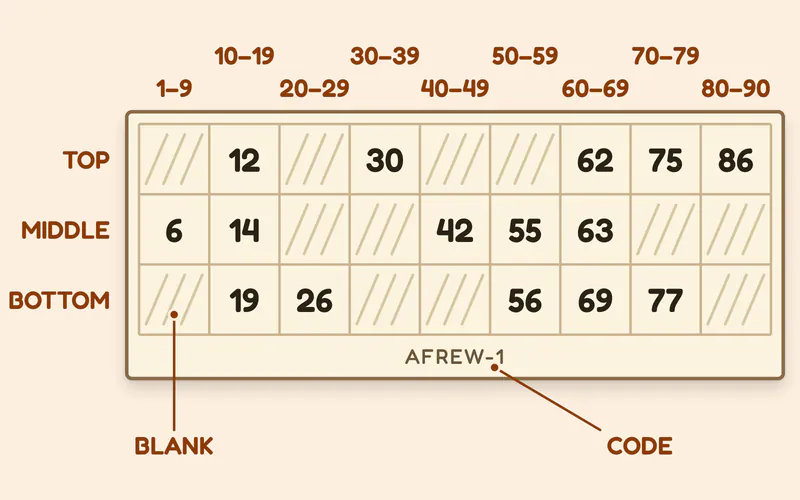
Ticket 1 of sheet AFREW. Every row has five numbers; every column holds numbers from its own range; the code under the ticket names the sheet and the ticket.
A tambola ticket has three rows and nine columns. It holds fifteen numbers, five in every row, and the other twelve cells are blank. The columns divide the numbers between them: the first column holds numbers from 1 to 9, the second from 10 to 19, the third from 20 to 29, and so on, with the last column holding 80 to 90, eleven numbers. Every column has one, two or three numbers on a ticket, never none, and they go up from top to bottom.
Tickets come in strips of six. The six tickets of a strip hold every number from 1 to 90 exactly once between them, so when six tickets are in play, every number called is on exactly one of them.
Each set of tickets here comes from a sheet code of five letters and digits, such as AFREW. The same code always makes the same tickets, and each ticket’s code adds its number on the sheet: AFREW-1, AFREW-2 and so on. The last character of a sheet code is a check, so a mistyped code is caught instead of being read as another sheet.
Who plays, and with which ticket
Each named player holds one ticket: the first player ticket 1 of the sheet, the second ticket 2, and so on. Players 1 to 6 share one strip and players 7 to 12 a second one. That makes 1 to 12 named players on one device. In an online room, everyone who joins holds a ticket on their own phone, up to 50 people, and the caller holds one too.
For a bigger group, add extra tickets in the setup, under More options, in whole strips of six, up to 300 tickets in all. They are numbered on from the named players’ tickets and come from the same sheet. A person playing an extra ticket has no name in the game: their ticket is “Ticket 27”, and they claim by its number or its code.
The numbers and the call
At the start, the phone shuffles the numbers from 1 to 90 once. Each call shows the next number of that order; no number comes twice. You can call by tapping Next number, or let the phone call every 5, 10 or 15 seconds, with Pause and Resume in between. Where the device has a voice, it can say each number aloud, then its digits: “Fifty-nine. Five, nine.”
Calling goes on while numbers are left and Full House has not been won. Players mark the numbers they hold, but the marks are only a help: a claim is always checked against the numbers called, marked or not, as a caller checks a paper ticket.
The claims
| Claim | What has to have been called |
|---|---|
| Early five | Any 5 of the ticket’s 15 numbers |
| Top line | All 5 numbers of the top row |
| Middle line | All 5 numbers of the middle row |
| Bottom line | All 5 numbers of the bottom row |
| Four corners | The first and last numbers of the top row and of the bottom row |
| Full House | All 15 numbers |
All the claims are open from the first number, and there is no order to win them in. Each claim has one place: the first player to claim it rightly wins it. Full House can have one or two places, an option in the setup; with two, the first Full House leaves the calling on and the second one ends it.
The corners are the outer numbers of the top and bottom rows, whatever columns they sit in: a blank cell is never a corner. On ticket AFREW-1 above, the corners are 12 and 86 on the top row and 19 and 77 on the bottom row.
For a shorter list, choose Lines and Full House only in the setup: Top line, Middle line, Bottom line and Full House.
Your move: which claim?
Four numbers, which claim?
You are Player 1. Only the ringed numbers on your ticket have been called. Which claim can you make?
Tap a claim under the ticket to check it.
Making a claim
On one device, anyone can tap Claim, then choose who is claiming and which claim. In an online room, each player taps the claim’s button under their own ticket instead, and nobody can claim for anyone else. The answer comes at once, in one of four ways:
- Valid. The ticket has every number the claim needs, and the player wins that claim.
- Valid, shared. The claim was won by someone else on this same number, and this ticket has it too: they share it.
- Too late. The claim was won on an earlier number. Nothing is checked and there is no penalty, but that player can’t claim it again, since there is nothing left to claim.
- Bogey. Some of the claim’s numbers have not been called. The phone says which ones.
Each ticket claims each claim once, whatever the answer. Step through three claims in one real game for four:
Step through: is this a claim?
Step 1 of 4: A game for four. 28 numbers have been called, and four of them are on Ana’s ticket.
Bogeys
A bogey is a claim made too soon, easy to do in the excitement. Here it costs only that claim: the player can’t claim it again, their other claims stay open, the claim stays open for everyone else, and nobody loses points or tickets. The phone shows the ticket with its called numbers marked and the numbers not called yet, so everyone can see why.
Two people, one claim
If two people claim the same claim on the same number, both win it and share the place, and each scores a point for it. That is the rule a family table plays: whoever spoke up on that number had it, and the phone can’t hear who shouted first. A share is only possible on the number the claim was won on; after the next call, the claim is closed.
A player who claims on the winning number without actually having the claim gets a bogey, as on any other number.
Full House and the end of the game
When the last Full House place is won, no more numbers are called. Claims are still taken on that number, so a second player with Full House on the same number can share it, and any other open claim can still be claimed.
On one device, the game ends when someone taps End game. That is the only way out once Full House is won or all 90 numbers are out, and it can be tapped at any time before. In an online room, the game ends by itself 20 seconds after the last Full House is won, and a Full House on that same number can still share it in that time. If the numbers run out with Full House unclaimed, every claim can still be claimed, because every ticket is then complete.
The result and the points
Everyone who won a claim wins. The order: the Full House winners first (the first Full House before the second), then whoever won more claims, then whoever won their first claim earlier. Each claim won is a point, and a shared claim is a point for each player who shares it; the points are added up over rematches. If nobody won anything, the game is a draw. Extra tickets can win claims, but they score no points in the tally.
Printing tickets
Print tickets, in the setup and in the More menu, prints every ticket of the game, only the named players’ tickets, or a run of strips, six tickets to a page, each with its code. The sheet’s code is printed too: type it in the setup another day, and the same tickets come back, so a printed sheet can be used again. A game with printed tickets keeps its sheet over rematches.
For up to four players, On this phone draws each player’s ticket on the screen instead, and they tap their numbers to mark them.
Big groups: offices, societies and online rooms
One phone can run tambola for a whole hall. The host calls and checks on a shared screen, or simply reads the numbers out, and everyone else holds a printed ticket: named players up to twelve, and extra tickets for the rest. When someone claims, the host types the ticket’s number or code into the claim sheet’s Another ticket field, and the phone checks it like any other.
When the players are in different places, an online room does the same with a phone each. The host opens the room and calls; up to 50 people join by link or code, each sees their own ticket, and each claims from their own phone. Printed extra tickets still work in a room, for anyone without a phone: the caller claims for them by ticket number.
What this version leaves out
- The last number rule. Some groups only accept a claim if the number just called completes it. Here a claim is checked against all the numbers called, and a late claim only fails if someone won it on an earlier number.
- Harsher bogeys. Some house rules put a ticket out of the game after a bogey. Here only that claim is lost.
- Rhymes for the numbers. Some callers give each number a rhyme; this version doesn’t, and the voice says the number and its digits.
- Several tickets per named player. Each named player has one ticket; use extra tickets for anyone else.
Glossary
- Bogey: a wrong claim; that player can’t make that claim again.
- Call: one number drawn and shown by the caller.
- Claim: saying your ticket has a pattern, checked against the numbers called.
- Full House: every number on the ticket called.
- Sheet code: the five letters and digits that make a game’s tickets.
- Strip: six tickets that hold every number from 1 to 90 once.
Ready to play? Open the tambola caller. To run a whole evening for a group, read the guide to hosting a tambola night.