Bingo is a calling game: numbers are drawn one at a time, players mark them on their cards, and the first card to show the pattern being played wins. This is 75-ball bingo, the kind with a 5 × 5 card under the letters B I N G O. This guide gives the rules exactly as the game on this site plays them, from the card to the end of a game, with the phone as caller and judge.
Overview
| Feature | Details |
|---|---|
| Players | One device: 1 to 12 named players, and up to 300 cards in all. Online: up to 50 people in a room |
| Numbers | 1 to 75, each called once with its letter |
| Card | 5 × 5: 24 numbers and a free space in the middle |
| Patterns | Line, Four corners, X, Blackout, or Line then Blackout |
| Winners | One per pattern, or two |
| Equipment here | One phone, tablet or computer with printed cards or cards on the screen; or, in a room, a phone each |
The card
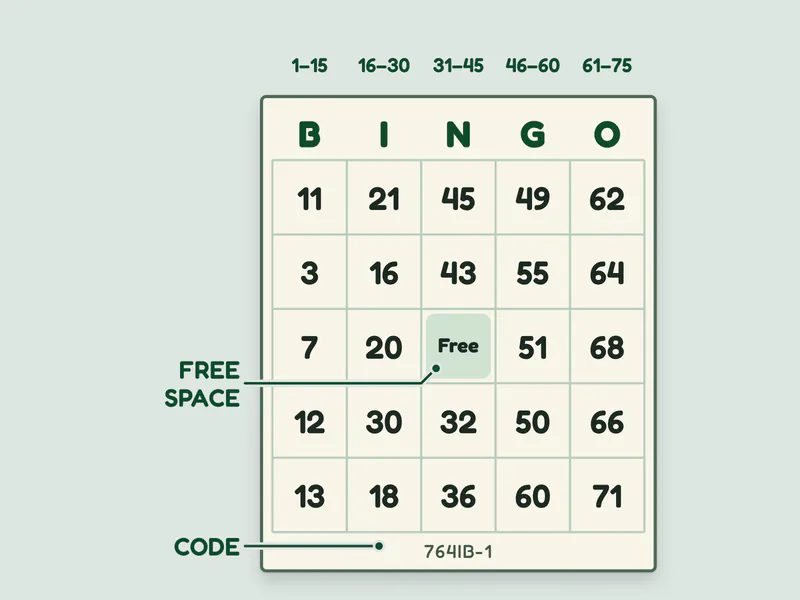
Card 764IB-1. Each column draws its five numbers from its own fifteen, and the square in the middle is free.
A bingo card has five columns under the letters B, I, N, G and O, and five rows. Each column takes its numbers from one block of fifteen:
- B: five numbers from 1 to 15
- I: five numbers from 16 to 30
- N: four numbers from 31 to 45, with the free space in the middle
- G: five numbers from 46 to 60
- O: five numbers from 61 to 75
That is 24 numbers. Within a column they come in no particular order. The letter tells you where to look: when the caller says “G 52”, the only place it can be is the G column.
The free space counts as called and marked from the first moment. You never have to do anything with it.
Each card here belongs to a sheet, named by a code of five letters and digits, such as 764IB. Card 1 of that sheet is 764IB-1, card 2 is 764IB-2, and so on. The same code always gives the same cards.
Who plays, and with which card
Each named player holds one card: the first player card 1 of the sheet, the second card 2. On one device up to 12 people can be named, and the game uses their names when they claim. In an online room, everyone who joins gets a card on their own phone, up to 50 people, and the caller plays one too.
Anyone else can play an extra card. Add them in the setup, under More options, a page of four at a time, up to 300 cards in all. Extra cards are numbered after the named players’ cards: with four players, the first extra card is card 5. Someone holding one is “Card 5” in the game and claims by that number or its code.
How numbers are called
When the game starts, the phone shuffles the numbers 1 to 75 once, and each call takes the next one. No number comes up twice. Each number is called with its column’s letter, “B 7”, “N 38”, “O 66”, and shown large on the screen with the two calls before it.
You choose how calls come in the setup, under Call numbers: When I tap (the default, with the Next number button) or by themselves every 5, 10 or 15 seconds, with Pause and Resume. On a device with a voice, the phone can also say each call: “B. Seven.” for a single digit, and “G. Forty-six. Four, six.” for two.
The board on the screen keeps every number called, covered with a counter, and rings the latest.
Marking your card
A call can only be in one column of your card, the one under its letter, so that is the only place to look. On a printed card, cross the number out or cover it; on a card shown on this phone, tap it. If you miss a call, the board still shows it, so you can catch up at any time before you claim.
Marks are only a help. A claim is checked against the numbers called, so a number you forgot to mark still counts, and a number you marked by mistake doesn’t.
The patterns
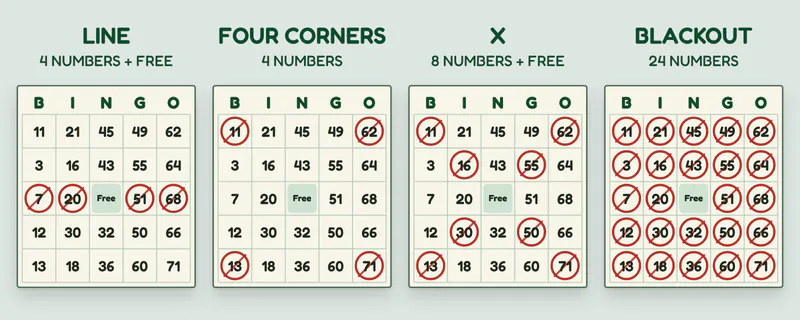
The same card marked four ways. The free space fills a gap in the middle row and in both diagonals, so those need four numbers each.
| Pattern | What has to have been called |
|---|---|
| Line | All of one row, one column or one diagonal (4 numbers through the free space, otherwise 5) |
| Four corners | The four corner numbers |
| X | Both diagonals: 8 numbers and the free space |
| Blackout | All 24 numbers on the card |
A card has twelve lines: five rows, five columns and two diagonals. The middle row, the middle column and both diagonals pass through the free space.
The setup’s Pattern option picks what a game plays:
- Line (the default), Four corners, X or Blackout: that pattern alone. When it is won, the game is over.
- Line, then Blackout: two patterns in turn. A line is won first and calling goes on; the game is over when someone covers the whole card.
Patterns overlap. An X always contains a line and the four corners, and a Blackout contains everything, but only the pattern being played can be claimed.
Your move: which pattern?
Which pattern?
You are Player 1. The ringed numbers on your card have been called. Which pattern can you claim?
Tap a pattern under the card to check it.
Claiming
Shout “Bingo!”, then claim. On one device, tap Claim: the claim sheet asks Who is claiming? (a named player, or Another card for an extra card, by its number or code) and Which claim?, then Check. In an online room, tap the pattern’s button under your own card; each phone claims only for its own card. Either way, the answer comes with the card drawn, its called numbers marked, and one of these:
- Bingo! Every number the pattern needs has been called. The pattern is won.
- Bingo, shared. Someone already won it on this same number, and this card has it too: they share it.
- Not yet. Some numbers are missing. The phone lists them, for example “Not called yet: G 54, O 66”.
- Too late. Only with Line, then Blackout: the line was won on an earlier number, so there is nothing left to win.
Each card can claim each pattern once, whatever the answer. Step through three claims in one real game for four:
Step through: is this bingo?
Step 1 of 4: A game for four, playing Line. 32 numbers have been called, and a line on Cy’s card looks full. Cy shouts Bingo.
Calling bingo too soon
A claim that comes before its numbers is answered Not yet. It happens: a misheard letter, a number marked on the wrong card. The cost is small and fixed. That card can’t claim that pattern again; everything else stays as it was. The game goes on, the pattern is still open for everyone else, and with Line, then Blackout, the card can still go for the other pattern.
Two winners on one number
If two cards complete the pattern on the same number, both win it. Whoever claims first gets Bingo!, and the second gets Bingo, shared, as long as they claim before another number is called. Nobody needs to argue over who spoke first.
With Winners per pattern set to 2 (under More options), a pattern has two places. The first winner leaves one open, “One more Blackout to win”, and calling goes on until the second is won.
The end of a game
When the last pattern is won, no more numbers are called. Claims are still taken on that number, which is how a share happens. On one device, tap End game to finish. If all 75 numbers are called before the pattern is won, End game closes the game with the numbers finished. In an online room, the game ends by itself 20 seconds after the last pattern is won, time enough for a share on the same number.
Everyone who won a pattern wins the game, the winners of the last pattern first. Each pattern won is a point for a named player. Extra cards can win too, and the result lists them by number, such as “Card 27”.
Printing cards
Print cards, from the setup or the More menu, prints the game’s cards four to a page, each with its code, and the sheet’s code on every page. With extra cards you can print all of them, only the players’ cards, or a range of pages. Type the sheet’s code under Cards at the next setup to play the same printed cards again; a game with printed cards keeps its sheet over rematches.
For up to four players, Cards: On this phone draws each card on the screen instead. Each number is a button: tap it to mark it, tap again to clear it.
The kids’ game: 1 to 25
Under More options, Numbers: 1 to 25 (kids) makes a smaller game for young players. Every card holds all the numbers from 1 to 25, five to a column (1 to 5 in the first, 6 to 10 in the second, and so on), with no letters and no free space. The phone calls “Number 14” and draws a board of five rows of five. Line, Four corners and X can be played; Blackout can’t, because every card would finish it on the same call.
What this version leaves out
- Other ranges of numbers. This game calls 1 to 75 (or 1 to 25 for kids). The game of 1 to 90 with tickets of three rows is Tambola on this site.
- Harder penalties. A wrong claim here costs that card that one pattern, and nothing more.
- Other shapes. Patterns such as a letter or a frame round the edge aren’t offered: the four here are the ones the phone checks.
- Several cards for one named player. Each named player has one card; extra cards cover everyone else.
Glossary
- Call: one number drawn, with its letter.
- Card: a 5 × 5 grid of numbers under B I N G O.
- Free space: the middle square, counted as called from the start.
- Not yet: the answer to a claim with numbers still to come.
- Pattern: the shape a card must complete to win: Line, Four corners, X or Blackout.
- Sheet code: the five characters that bring back the same set of cards.
Ready to play? Start a game of Bingo. For running a game for a class or a crowd, read the guide to hosting a bingo game.