In carrom, each player shoots a heavy disc, the striker, from their own edge of the board and tries to sink coins in the corner pockets. In the classic game White plays nine white coins and Black nine black coins, and between them at the start sits the red queen, which belongs to whoever pockets it and then covers it with a coin of their own. The first side to pocket all nine coins with the queen covered wins the board. This guide gives every rule as this site plays it, for two players or four in pairs, then the Points game for two, three or four.
Overview
| Feature | Details |
|---|---|
| Players | 2, or 4 in two pairs; 2, 3 or 4 in the Points game (any seat may be the computer) |
| Typical time | 5 to 25 minutes |
| Equipment | A square board with four corner pockets, 9 white coins, 9 black coins, 1 red queen and a striker |
| Other names | Carom, karrom; the coins are also called carrom men |
| A board | One game, until one color has all nine coins off |
| A match | First to 25 points, over as many boards as it takes |
The board and the pieces
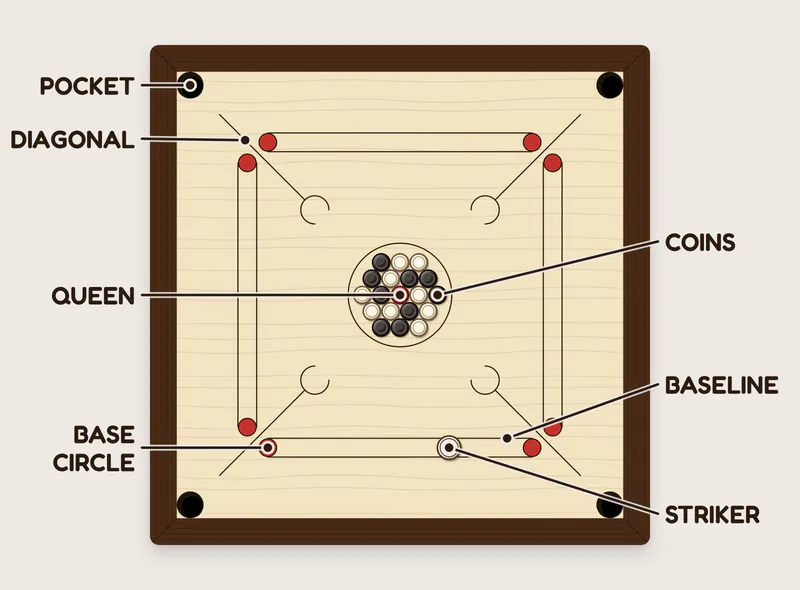
The board at the start of a board, seen from White’s side. White shoots from the baseline at the bottom, Black from the one at the top.
The playing surface is square, with a pocket in each corner and a wooden frame all round whose inner edges are the cushions the discs bounce off. Along each side runs a baseline: two straight lines ending in a red base circle at each end. Diagonal lines run from each pocket toward the middle; no rule here uses them, but they help your eye. A circle in the center marks where the coins start, with a red spot at its heart.
The pieces are the coins, nine white and nine black, the red queen and the striker, a bigger disc with a star on it. The striker is three times as heavy as a coin, which is why it can move a whole cluster at once. Coins and the queen all weigh the same.
Setting up and the break
The queen starts on the center spot, ringed by six coins and then twelve, the colors alternating. The game sets this up for every board.
White breaks the first board. In a match, White breaks the next boards too, unless you choose Last board’s winner under Who breaks in More options. The break is a normal shot: a white coin in and White shoots again; nothing in and the turn passes to Black.
Where the striker stands
Before every shot you place the striker on your own baseline: its center on the baseline, anywhere between the two base circles, not overlapping a coin. The striker must then go forward, into the board, straight or at any angle, never backward toward your own edge; the game allows only legal shots. A coin behind your baseline can still be reached off a cushion.
A turn
A shot follows the same order every time:
- You shoot. Place the striker, aim and choose a power. In this game you slide the striker with the bar under the board, then press the striker and pull back: the shot goes the opposite way and the pull’s length is the power. Beside a wide board, a power bar on the right does the same along your aim. Letting go shoots.
- Coins of the other color that went in stay off the board and count for their owner, whoever pocketed them.
- The striker went in? That is a foul, explained below, and your turn ends.
- Coins of your color that went in stay off the board and count for you.
- You shoot again if you pocketed at least one coin of your color, even if a coin of the other color went in too. Otherwise the turn passes to the next player.
A shot that pockets only the other color’s coins helps them twice: the coins count for them, and your turn ends.
With two players, White sits at the bottom and Black at the top. You may hit the other color’s coins to clear a path, but pocketing the last of them loses the board (see The last coin).
Four players in pairs
With four players, the classic game is played in two pairs. In the examples, Ana and Cy play White and Ben and Dee play Black. Partners sit opposite each other, and every player shoots from their own side of the board. Play goes round the board: Ana, Ben, Cy, Dee, then Ana again.
- You shoot again, not your partner. A coin of your own color means another shot for you. Otherwise the turn goes to the next player round the board, who is always one of the other pair.
- The pair shares everything else. The coins off the board, the queen, its cover, a coin owed and the points all belong to the pair. A coin counts for its color whoever pocketed it: “Ben pocketed a white coin for Ana and Cy.”
- The queen’s cover stays with the shooter, who shoots again to cover it. A coin owed is the pair’s.
- The board ends for the pair, by the same rules as for two: “Cy pocketed a white coin. That clears the board: Ana and Cy win it with 4 points, 3 of them for the queen.”
- Who breaks. With White breaks each board, Ana breaks every board; with Last board’s winner, the first player of the winning pair breaks the next.
| In order of play | Coins | Shoots from |
|---|---|---|
| Ana | White | the bottom |
| Ben | Black | the right |
| Cy | White | the top |
| Dee | Black | the left |
The queen and its cover
The queen is worth three points to the player who wins it, but it has to be covered: after the queen goes in, you must pocket a coin of your own color.
- Queen and one of your coins on the same shot: covered at once. The queen is yours and you shoot again.
- Queen alone, and you already have a coin off the board: the queen waits for its cover and you shoot again. Your next shot must pocket a coin of your color.
- Queen alone, before any coin of yours is off the board: too early. The queen goes back to the center.
- The cover shot: any coin of your color covers the queen. If the shot pockets nothing, or only coins of the other color, the cover has failed and the queen goes back to the center.
Once covered, the queen stays yours for the rest of the board. Step through a real example: Ana plays White and already has coins off the board.
Step through the queen and its cover
Step 1 of 5: Ana plays White and already has coins off the board, so she may pocket the queen (the red coin near the top left pocket).
With the easy rule, Counts any time (Queen, under More options), the queen counts for whoever pockets it, at any time, with no cover needed, and that player shoots again. The last-coin rule below still applies: the queen must be off the board before your last coin.
Fouls: the striker in a pocket
If the striker drops into a pocket, it is a foul and your turn ends. Then:
- any coins of your color that went in on that shot come back to the center;
- the queen comes back to the center if it went in on that shot, or if it was waiting for its cover;
- one more of your pocketed coins comes back to the center as the penalty.
Coins of the other color that went in on the foul stay off the board for their owner. So the queen and the striker on the same shot is a foul like any other, and a foul while the queen waits counts as a failed cover. Returned coins and the queen go on the center spot if it is free, or on the nearest free spot to it, the queen first.
The coin owed (the due)
If you have no coin off the board when you foul, there is nothing to give back yet, so you owe a coin. The next coin of your color to leave the board pays the debt: it goes straight back to the center. It pays even if your opponent pocketed it, and if you pocketed it yourself you still shoot again (and it still covers a waiting queen). The badge shows “owes 1 coin” until the debt is paid. A player never owes a coin while they have one off the board to give back.
The last coin
A board ends the moment one color has all nine coins off the board. Who wins depends on whose coin went in last, and on the queen.
- Your ninth coin, with the queen covered (by you or by your opponent): you clear the board and win it.
- Your ninth coin while the queen is still on the board or waiting for its cover: you lose the board. This is the last-coin rule: the queen must be covered before your last coin goes in.
- The other player’s ninth coin, pocketed by you: you lose the board, because you have finished it for them. This holds even if the striker also went in, and even if your own last coin dropped on the same shot.
So with your last coin and the queen both still on the board, the queen has to come first. Try it:
Your move: the last coin
The last coin and the queen
You are White. Your last white coin and the queen are both still on the board. Which do you pocket?
Tap the disc you would pocket: the queen, your white coin or a black coin.
Scoring a board
Only the winner of a board scores:
- Cleared the board: one point for each coin the loser still has on the board, plus three for the queen if the winner covered it.
- Last coin before the queen: the other player wins, with one point for each of their own coins still on the board, plus three for the queen.
- Their last coin: the other player wins, with one point for each of the shooter’s coins still on the board, plus three for the queen unless the shooter had covered it.
A winner who already had 21 points or more before the board gets no points for the queen.
| Worked board | What happens | Points |
|---|---|---|
| 1. A single board | White has covered the queen and pocketed eight coins; Black has three coins on the board. Ana (White) pockets her last coin. | 3 for Black’s coins + 3 for the queen = 6 to Ana |
| 2. A match at 21–14 to White | The queen is still on the board; White has two coins left and Black one. Ben (Black) pockets his last coin. | 2 for White’s own coins, 0 for the queen (White already has 21) = 2 to Ana, who leads 23–14 |
A 25-point match
Choose First to 25 points under Match to play boards until one player reaches 25. Each new board is set up and starts by itself. Only a board’s winner scores, so there is no tie to break, and the board that takes a player to 25 or more wins the match, even if it overshoots: “Ana wins the match, 26 to 4”.
The Points game
Choose Points: every coin counts under Game for a second game on the same board and with the same controls. Everyone plays for themselves, with no color of their own. It is the only game for three and a choice for two and four, always a single board. These are this site’s rules for it:
- Sides. Each player shoots from their own side, from the baseline as in the classic game, and play goes round the board. Two sit opposite; three take the bottom, right and top sides, and the left stays empty; four use all four sides.
- The break. The first player breaks. It is a normal shot: if it pockets nothing, the turn passes.
- Any coin is yours. A black is worth 10 points and a white 20. Pocket any coin and you shoot again; otherwise the turn passes to the next player round the board.
- The queen may be pocketed at any time, but it counts only once covered: pocket any coin on the same shot or your next one, and it is yours for 50 points, on top of the coin’s. If your next shot pockets no coin, the queen goes back to the center.
- A striker foul ends your turn. The coins of that shot go back to the center and score nothing, and so does the queen if it fell on that shot or was waiting for your cover. Your cheapest coin goes back too, with its points: a black if you hold one, else a white. A covered queen is never given back.
- The end. The board ends when no white or black coin is left. A queen still on the board counts for nobody. The most points win, and equal top scores share the win.
- Conceding. A player who concedes is out: their points stay and they take no more turns. The last player left wins.
| In the Points game | Points |
|---|---|
| A black coin | 10 |
| A white coin | 20 |
| The queen, once covered | 50, on top of the covering coin |
| A striker foul | The shot’s coins score nothing, and your cheapest coin goes back: minus 10 or minus 20 |
| The whole board | 90 for the blacks + 180 for the whites + 50 for the queen = 320 |
What this version leaves out
These are family rules, set so that a computer can referee every shot. Compared with tournament carrom, this version:
- has no thumb shots or back shots. Every shot is the striker from your baseline, forward into the board.
- has no improper-stroke fouls. Here the only foul is the striker in a pocket.
- plays three only in the Points game. The classic game is for two, or four in two pairs.
- has no time limits and no limit on the number of boards in a match.
Ready to play? Start a game of Carrom, or read the carrom tutorial for aiming, power and the queen.