A real estate board game is one where you roll the dice, walk round a track of places, buy what you land on and charge rent to everyone who lands there after you. Own a whole group of places and you can build on them, which makes the rent climb, so the game turns into trading: everyone wants the one place that completes their group. In India this family of games is simply called Business. Below is how these games work, where the idea came from, the house rules that make every table a little different, and how to play one free on one phone with Business Tycoon, our own property trading game.
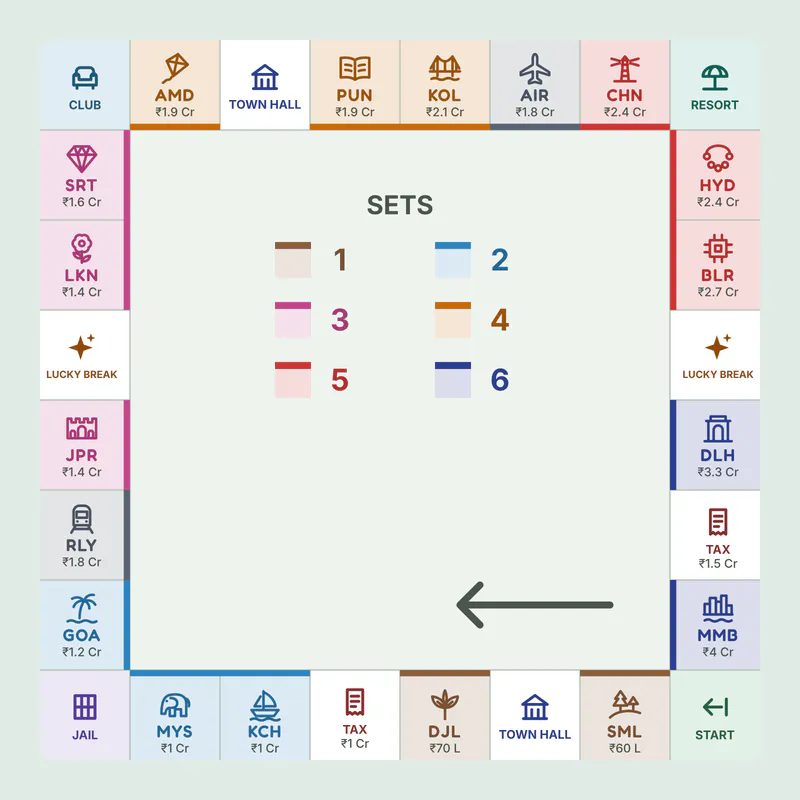
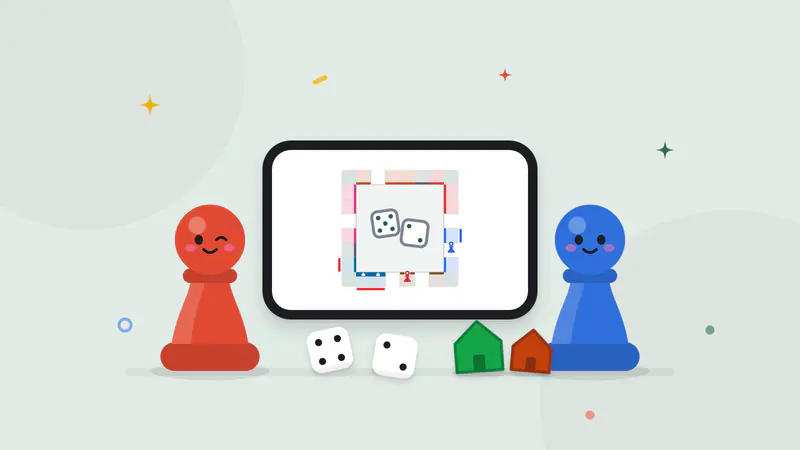
A property trading board, our 8 × 8 one: 28 spaces round the edge, Start in the bottom right corner, and six coloured sets of places that get dearer as you go round. Between them sit two transport spaces, card spaces, taxes and three more corners: Jail, Club and Resort.
What makes a property trading game
Every game in the family shares the same handful of ideas, whatever its board shows:
- A track of places. The board is a loop of spaces. Most are places for sale, in small groups that share a colour; the rest are corners, taxes and card spaces.
- Roll and move. Two dice decide how far you go. You can’t choose where you land, but you can choose what to do there.
- Buy or pass. A place nobody owns can be bought at its price. Pass on it and, depending on the rules, it stays for sale or goes to auction.
- Rent. Land on a place someone else owns and you pay them. A single place charges little; a whole set charges more.
- Build. Once you own a whole set, you can put homes on it, and every home raises the rent. This is where games are won.
- Trade. Sets rarely fall into one player’s hands by luck, so players swap places and cash to complete them.
- Run out of cash. If you can’t pay, you sell homes and mortgage places to raise money. When nothing is left, you are out.
The ideas feed each other in a loop: buying gives you places, places earn rent, a whole set lets you build, and building brings in more rent to buy and build again.
Where the idea came from
The family goes back more than a century. On 5 January 1904, Lizzie J. Magie of Brentwood, Maryland, was granted a United States patent for a board game she called The Landlord’s Game. Players went round a square track of properties, paid rent to the owners and could be ruined by it. Magie meant the game to show how rent on land moves money from tenants to owners, and versions of it came to offer two sets of rules: one where a single player grows rich at everyone else’s expense, and one where wealth that is created is shared and everyone can prosper. She patented a revised version in 1924.
Through the 1910s and 1920s people copied the board by hand, renamed the places after their own towns and changed the rules as they went. In the 1930s a version of it was published commercially in the United States and became famous around the world. Since then the same ideas have turned up in many boxed games, apps and home-made boards. In India, toy makers sell their own boards with Indian cities on them, and the game is known simply as Business.
The same game, different tables
Because the game spread by copying, no two families play it quite the same way. These are the differences you are most likely to meet:
- Auctions. In some rule sets a place that the player who lands on it doesn’t buy is auctioned to everyone. Others simply leave it for sale.
- Money in the middle. A popular house rule puts taxes and fines in the middle of the board for whoever lands on the free corner.
- Extra spaces. Indian boxed sets often add spaces of their own, such as a club, a rest house or a wealth tax, each with its own rule.
- Starting money. The amount each player starts with changes from set to set, and some families deal out more to make the game gentler.
- The end. The classic ending is the last player left. Many families stop at a set time or after a number of laps and count who is richest instead.
None of these is wrong, as long as the table agrees before the first roll. On our site the choices are made in the setup: there are no auctions, money in the middle is the Pot on Resort option, Club is a corner with a fixed fee, and you pick Quick (a set number of rounds) or Classic (the last player left). The Business game rules list every rule as our game plays it.
A turn, step by step
The best way to see how the ideas fit together is to watch two players take a turn each. Asha and Dev are playing on the India board. Step through what happens when one of them buys a place and the other lands on it:
Step through a turn and the next
Step 1 of 6: Asha and Dev have moved three times each, paying the Income tax and the club fee on the way, and stand on Resort with ₹13.5 crore each. Nothing is bought yet. Asha rolls next.
Notice how little there is to tap. Rent is paid by itself the moment a token lands, so the only real choices in that sequence are Buy or Pass. That is typical of the family: most turns are quick, and the thinking happens before you roll, when you decide what to build and what to offer in a trade.
What to look for in a version on a phone
Playing on a phone or tablet takes away the banker, the counting of notes and the arguments about who paid what. A few things make a phone version work well at a table:
- One device, passed round. Everyone sees the same board, and nobody needs an account or an app.
- Computer players for the seats your group can’t fill, so two people can still have a full table.
- A length you choose, so a game fits an evening instead of running past midnight.
- Saving after every move, because a game this long is sure to be interrupted.
- Offline play, for trips and places with no signal.
- Online rooms for the nights when the family is in different cities.
Play a property trading game free
Business Tycoon is our own version of the family: a board of 28 spaces and six sets, or 36 spaces and eight sets on the bigger 10 × 10 board, homes and a tower, trades between players, and two kinds of card space called Lucky Break and Town Hall. It has five boards (India, the United States, the United Kingdom, Australia and the Planets), each with its own places and currency and all with the same rules. Two to six people can share one phone, any seat can be a computer player at Easy, Medium or Hard, and a Quick game ends after 10, 20, 40 or 80 rounds, with 20 as the default. Quick starts on the 8 × 8 board and Classic on the 10 × 10, and either can be played on both. It is free, with nothing to install, and it works offline after your first visit.
To play with friends on their own phones, play the Business game online with friends in a room. For the full rules read the Business game rules; to start winning, read how to win the Business game; and to choose how long your game should run, read how a Business game ends.