Truth or Dare on your own devices
Truth or dare works when everyone can see the question, and online each player has it on their own phone. Start a room and share the link with the group, whether you are on a video call or on the same sofa, and the game picks whose turn it is, by spin or in order. The host chooses the Kids, Family or Friends decks before you start: the same family-friendly truths and dares as our one-phone game.
Free for 2–12 players, each on your own phone, tablet or computer. Share a link or a 6-character code; nobody needs an account or a download.
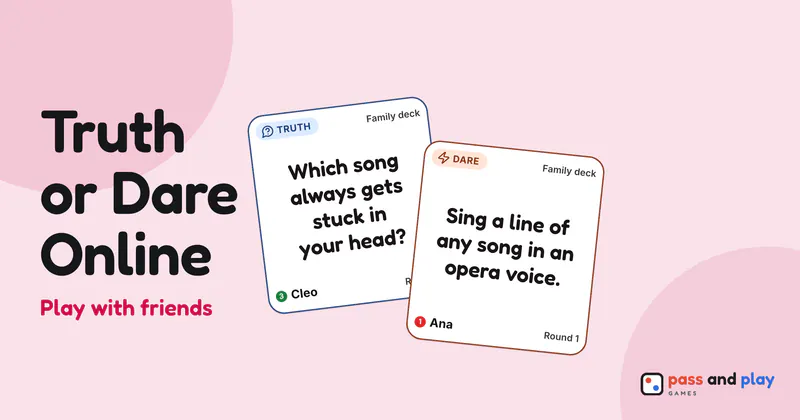
How to play truth or dare online with friends
Online, truth or dare is a multiplayer party room, so nobody has to pick a seat. Everyone who opens the link before the host taps Start gets a place, up to twelve players, and the lobby shows the group as a grid of names with a count of who is here. Anyone who arrives after the game has started can watch the cards but doesn’t get turns, so send the link round first and wait for the last name to appear.
The host sets four things in the lobby, and every phone sees the choices as they change:
- Decks: any mix of Kids (6–12), Family and Friends (teens+). At least one has to be picked.
- Rounds: Endless, 3, 5 or 10. A round is one turn for each person.
- Turn order (under More options): Spin, where the game picks a fresh random order every round, or In order, round the list.
- Skips each (also under More options): 0, 1, 2 or 3 per person.
Nobody chooses who goes first. In Spin, the names roll and stop on someone; In order starts the first game at the top of the list.
What a turn looks like when everyone has their own phone
Every screen shows the same moment: the name whose turn it is, then the truth or dare they drew. Unlike a board game, the buttons aren’t locked to the person on the card. Anyone with a seat can tap Truth, Dare or Random, and Done or Skip once the answer is in. That sounds odd, but it suits a call: the person doing a dare often has their hands full, so whoever is reading can move the game on. It also means a game doesn’t stall when one player’s phone goes to sleep or loses signal, because someone else can tap for them.
Within one game, a card doesn’t come back until every card of that kind in your chosen decks has been dealt. Skips are counted per person: once yours are used up, Skip is switched off for you, with a note saying why. When the last round ends, or anyone with a seat taps End and confirms, every phone shows what each player did: truths answered, dares done and skips used. Nobody wins and nobody loses. The host can then start a rematch in the same room with the same decks.
Tips for truth or dare with friends on a video call
- Keep cameras on. The room has no chat or video of its own, so run it next to your video call. Dares only land when the group can see them, and every built-in dare works at home in under a minute.
- Pick a set length for a call with a time limit. Three or five rounds give everyone the same number of turns. Endless runs until someone taps End.
- Choose decks for the youngest person on the call. The deck chips sit in the lobby for everyone to see, so parents on the call know which cards are coming before anyone taps Start.
- Mixed groups: if half of you share a sofa and the rest are on the call, the QR button in the room lets the people in the room scan straight in, while the link goes to everyone else.
- Agree who taps End. Anyone seated can finish the game, so it helps to leave that to the host.
The truth or dare rules cover skips, house rules and keeping the game kind, and the truth or dare hosting tips help you choose decks for your group. Everyone in one room with a single phone? Play truth or dare on one phone instead. For the next game on the call, try these never have I ever questions.
Rooms are private and close by themselves after the game; the server keeps a room’s names and moves only while it is open. See the privacy policy for the details.